Over the previous six breakdowns, we explored the strategic, psychological, and technical fundamentals required to turn cold clicks into high-margin clients. Yet even when you complete every piece of market research, craft an irresistible offer, chunk your funnel goals, and install custom tracking cookies, your acquisition engine can still fail completely.
In Section 7 of the AdSkills Traffic Traps masterclass, the instructor introduces the final and most dangerous trap: Traffic Trap #7: Poor Ad Buying Education. This is not merely another conceptual bottleneck. It is the original, multi-billion-dollar structural trap built directly into the software interfaces of every major ad network.
1. The Original & Biggest Traffic Trap of All
The instructor explains why this final hurdle is so uniquely catastrophic:
"Over the last six lessons, you learned about the fundamental tasks every company needs to complete to have a chance at succeeding with paid traffic. But now you're facing the biggest traffic trap of all. It's the original traffic trap, and what makes it more challenging than the others is that it's not a single trap: it pertains to every single ad network. Each network has little technical nuances, automatically checked boxes, and hidden options that cause advertisers to waste billions of dollars in ad spend."
The fundamental imperative for any business owner looking to scale profitably:
"If you ever want the opportunity to win with paid traffic, the first thing you have to do is STOP LOSING."
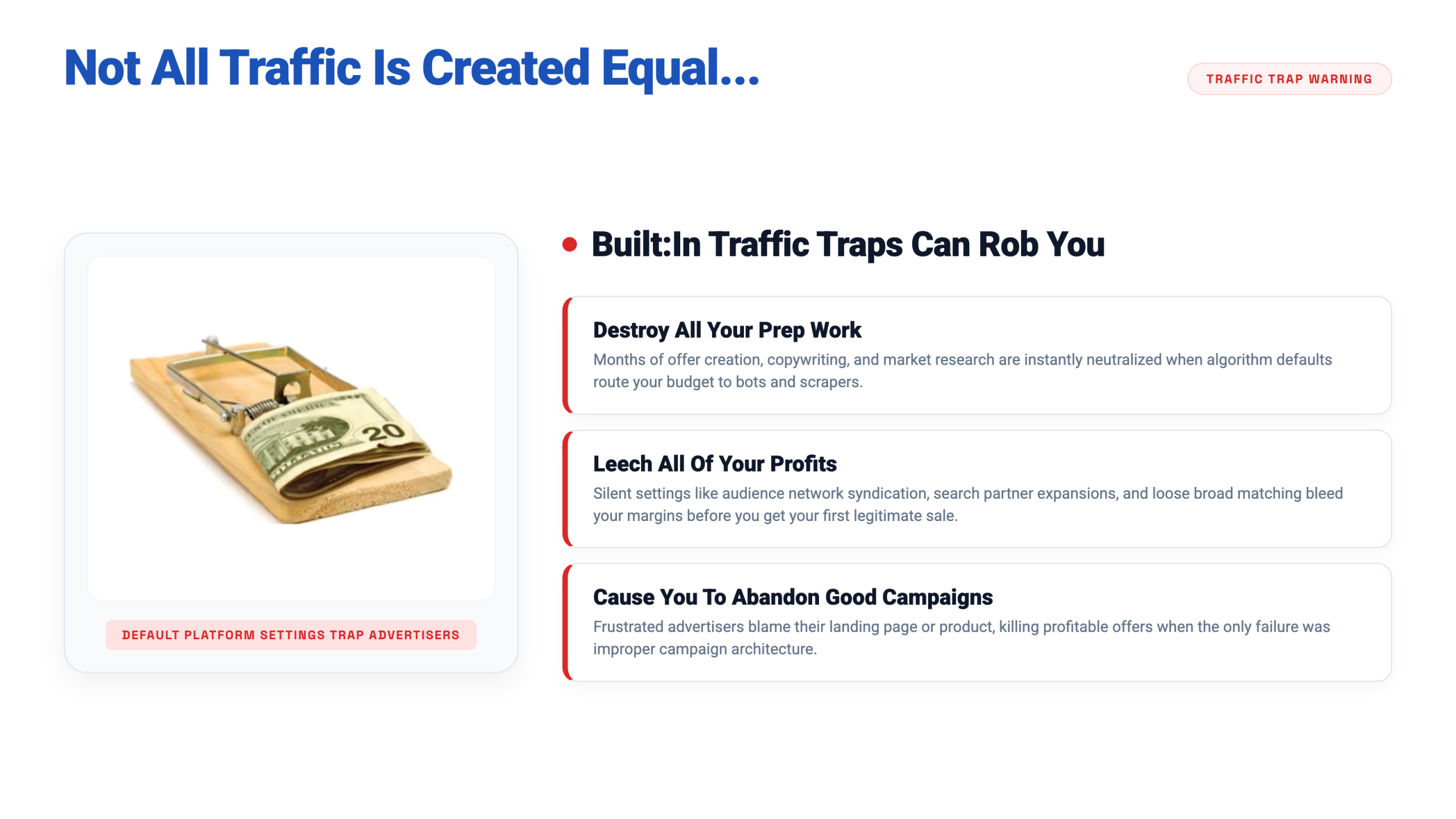
Before attempting sophisticated scaling hacks or expanding ad budgets, you must eliminate the automatic, built-in bleeding that drains up to 70% of typical ad accounts.
2. The VIP Illusion: Why Ad Networks Will Not Save You
Many founders assume that because ad platforms provide automated recommendations and support reps, the platform will look out for their financial interests. The instructor dismantles this illusion:
"You'd like to think the ad networks would point out the areas where you're wasting money, and they try to. But with millions of advertisers, they only have so many resources to go around, and those resources get allocated to the companies spending millions or billions a year. The people without six-figure ad budgets don't get the luxury of VIP service. Which means they have to figure out how to do things correctly on their own. And that usually leads to them reading a few blog posts or hiring someone who knows some digital marketing buzzwords... and they end up wasting their ad budgets."
3. The Keywords vs Search Terms Trap (Google Search)
To demonstrate how poor education costs advertisers fortunes, the instructor dissects how Google Ads actually works:
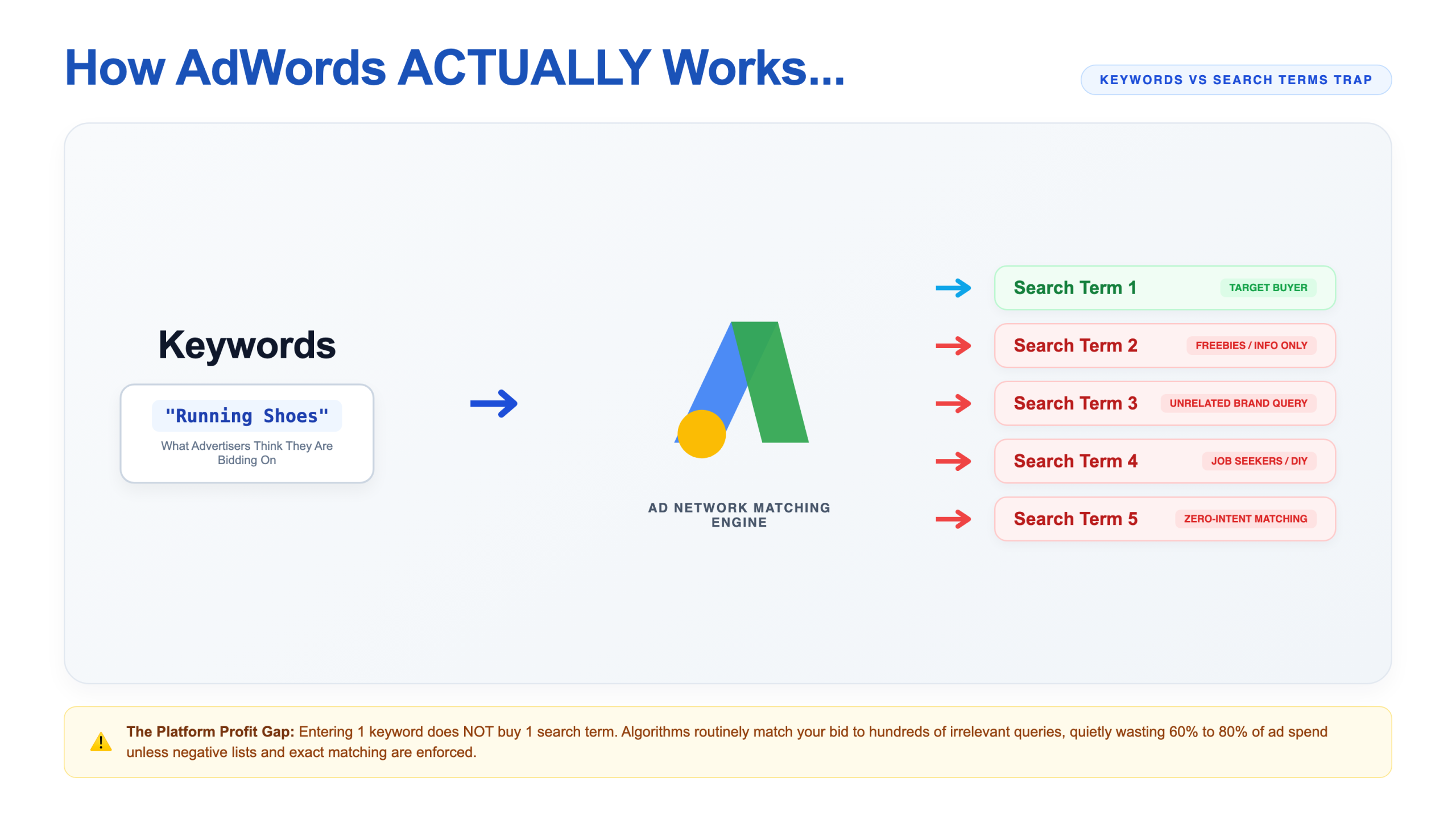
"You may have determined that AdWords is the right platform to capture low-hanging fruit. You've researched your avatar, created a killer offer, and set up your tracking. But if you don't give AdWords extremely clear instructions, you'll end up spending more than you make. You went in thinking keywords were the difference maker. After all: keyword research is all anyone in the blogosphere talks about!"
Here is the technical reality that drains accounts:
"Unfortunately, keywords really aren't all that important to AdWords success: Search Terms are. See: keywords are the inputs you give to AdWords, your 'Simon Says' instructions on the type of searches you'd like to advertise for. But they're not actually what your ads show up for. Those are the Search Terms: the actual phrases people type into Google that cause your ads to trigger and click."
What happens when advertisers fail to audit Search Terms and maintain aggressive negative keyword lists?
"Due to poor education, this is an often neglected activity that causes most businesses I've audited to spend nearly 70% of their budget on search terms they would never choose to advertise for! And it's all because they didn't have proper education on how to buy on AdWords."
4. Hidden Defaults Across Networks & The $500,000 Result
This problem is not unique to Google. Every advertising network is configured with hidden defaults that prioritize platform profit:
"These types of traffic traps are everywhere. Every single ad network has automatically checked boxes that you don't want checked. Some platforms default to allowing extremist content: you have to manually turn it off. Some platforms utilize audience networks, which means your ads are served outside of the network you paid to advertise on. Lots of ad network training provides recommendations that professional media buyers would never tell you to do."
By educating advertisers on how to identify and disable these hidden platform defaults, AdSkills achieved remarkable measurable outcomes:
"Over the last two years, we've helped companies cut more than half a million dollars ($500,000+) of wasted ad spend from their accounts. And that's just trimming the fat! Along with those impressive results, we've also helped them set up their campaigns to successfully utilize these paid networks to drive traffic that increases their revenues and keeps their businesses growing."
5. The 7 Costly Traffic Traps Master Blueprint
This masterclass provides a complete direct-response operating system. Here is the master synthesis of all seven traps and their counter-solutions:
-
Traffic Trap #1: Poor Expectations
The Fix: Understand that paid traffic is not referral marketing. You are responsible for turning paid traffic into paying customers. Respect the math: calculate CAC, LTV, and ensure your conversion pipeline supports cold acquisition. -
Traffic Trap #2: Inadequate Market Research
The Fix: Conduct the 5-step research protocol: Map the competitive landscape, identify the emotional gap in customer understanding, build pro and anti personas, align copy with the 5 stages of awareness, and architect the 3-phase buyer's journey. -
Traffic Trap #3: Good Product, Bad Offer
The Fix: Avoid the Shark Tank overvaluation mistake. Realize that a product is not an offer. Build a 3-part proposition: Pitch (emotional desire), Product (tangible specs), and Deal (slanted in customer's favor via terms, timing, bonuses, and risk reversal). -
Traffic Trap #4: Unclear Goals
The Fix: Eliminate complexity: the enemy of action. Respect the Rule of 7 in short-term memory. Chunk your funnel into discrete independent variables (top opt-in, middle purchase, bottom upsell) so you can stack-rank winners and cut losers. -
Traffic Trap #5: Poor Tracking & Analytics
The Fix: Stop settling for plain sugar cookies. Decorate your cookies with the 4 core UTM toppings (medium,source,campaign,content). Upgrade from an Easy-Bake Oven to a Viking Professional Range with custom conversion goals. -
Traffic Trap #6: Lack of Campaign Planning
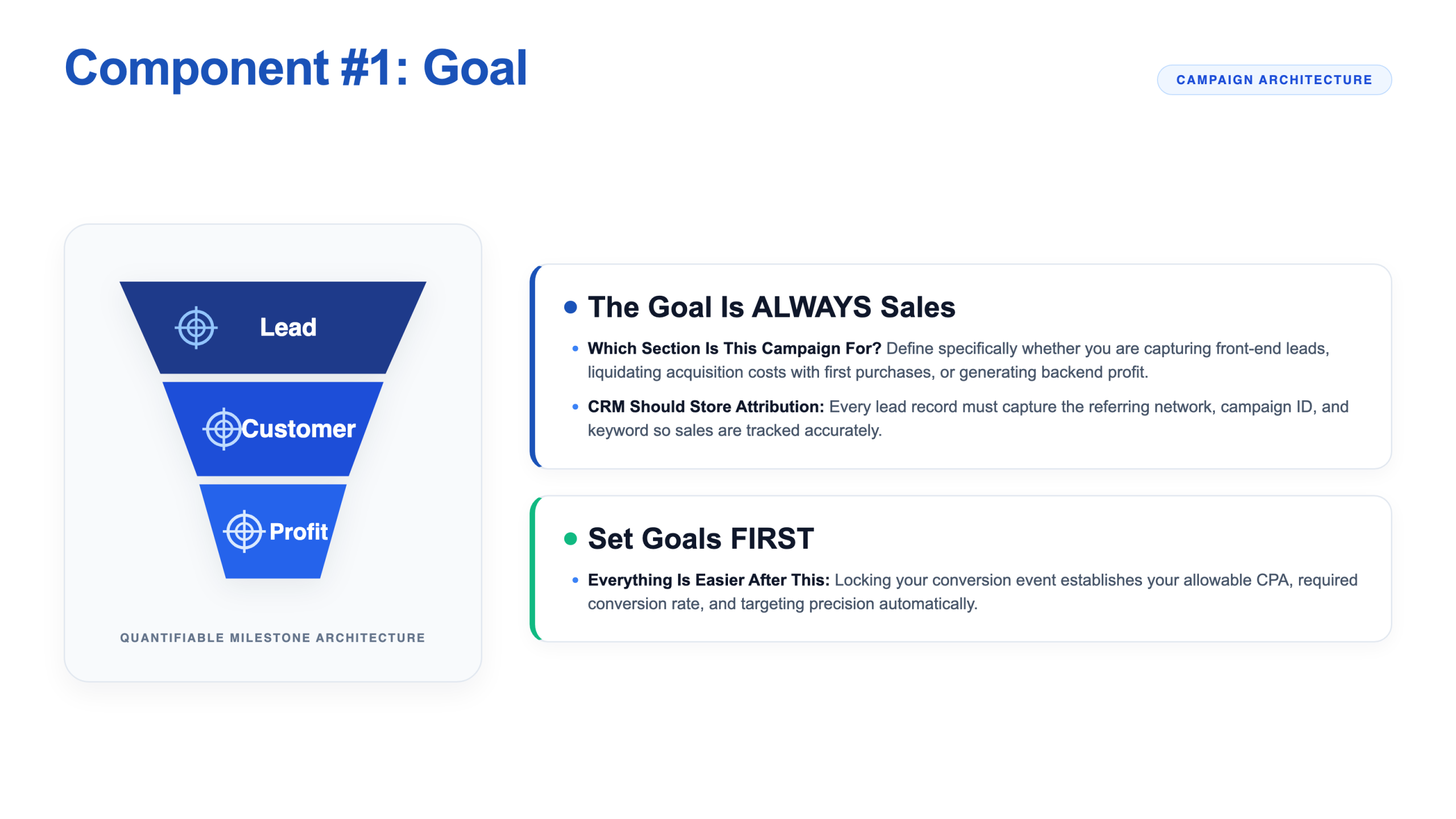
The Fix: Never "wing it" like an undisciplined shopper on a wedding diet. Win the game of Simon Says by completing all six planning pillars (Goal, Test Budget, Channel, Ad Persona, Creative, Tracking) before opening ad managers. -
Traffic Trap #7: Poor Ad Buying Education
The Fix: Stop losing before you try to win. Audit Search Terms, disable Audience Networks, segment mobile traffic, and rely on timeless direct response fundamentals rather than temporary algorithm tricks.
6. Digital Advocators Members-Area Tool: The Media Buying Audit
To inspect your active campaigns and immediately purge wasted ad spend:
- Tool Name: The Media Buying Education & Hidden Platform Traps Audit
- Purpose: A comprehensive diagnostic checklist that identifies the 5 most costly platform traps (Search Terms vs Keywords, Audience Networks, broad match leakage, mobile click spam, and automated algorithmic recommendations).
- Access: Available inside your Digital Advocators Member Portal.
