In Section 6 of the AdSkills Traffic Traps masterclass, the instructor tackles the widespread habit that turns promising marketing ideas into expensive failures: Traffic Trap #6: Lack of Campaign Planning.
Most media buyers log into Facebook Ads Manager, Google Ads, or TikTok, click the bright green "Create Campaign" button, and immediately start guessing their way through audience fields, daily budgets, and ad copy. They treat campaign execution like an impromptu brainstorm rather than a disciplined engineering project.
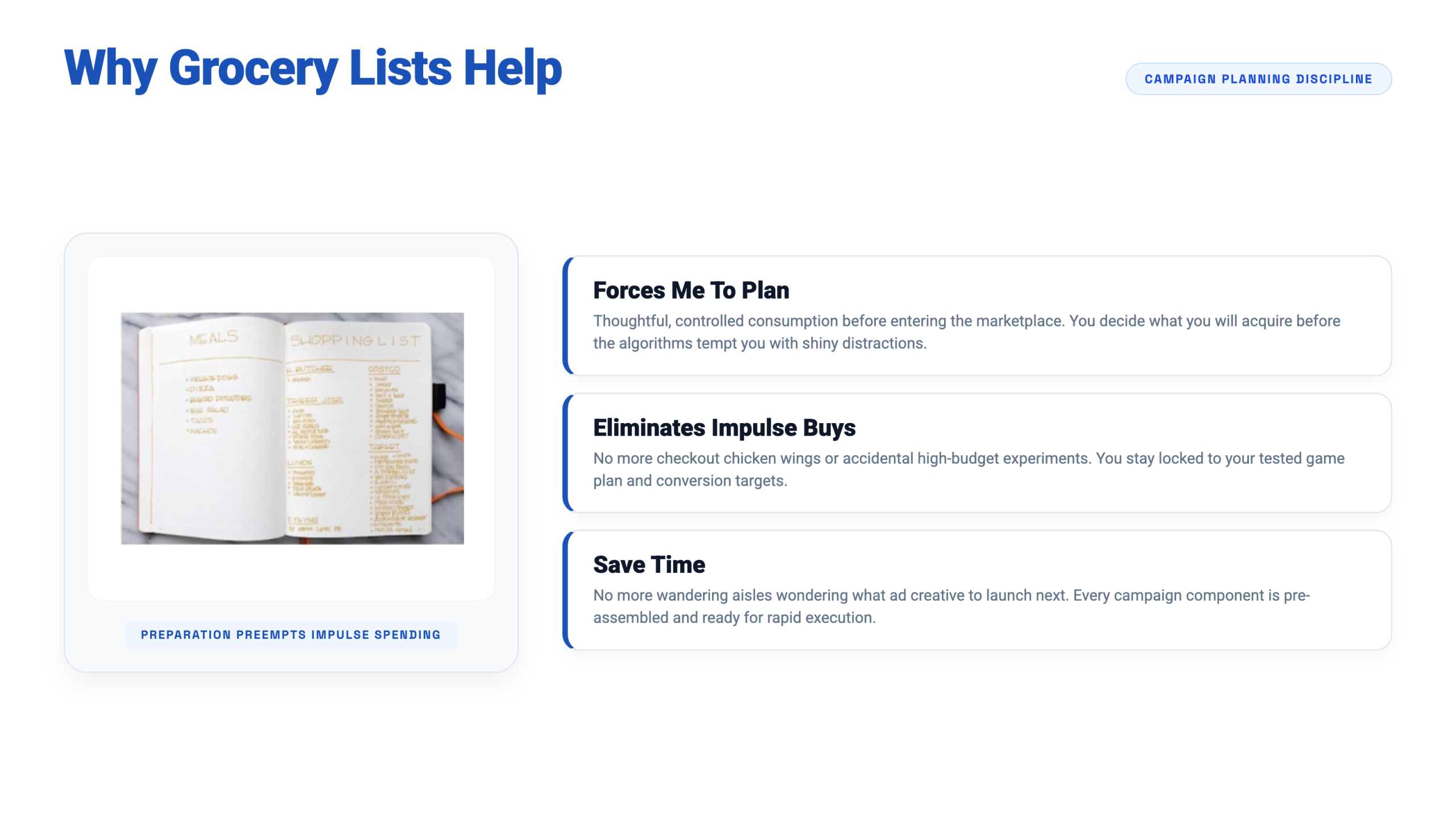
1. The Wedding Diet Grocery List Parable
To demonstrate why improvisation leads to disaster, the instructor shares a vivid personal story:
"I'm in the final six months leading up to my wedding, and I've been working to get in great shape for the big day. But if you go to the grocery store without a grocery list, what happens? You buy junk food, you buy things on impulse, and you waste both money and time. Having a plan ahead of time forces you to eliminate impulse buys, saves you hours in the store, and keeps you laser-focused on your end goal."
The parallel inside digital marketing is identical:
"The exact same thing happens in marketing: people just wing it. They open their ad accounts with zero plan, throw some money at whatever options look good in the moment, and wonder why they lost their shirt. They blame the platform, when the truth is they failed to complete the six fundamental components of a campaign plan."
2. Paid Media as a High-Stakes Game of "Simon Says"
The instructor issues a blunt reality check about how modern self-service ad platforms operate:
"If you didn't know: paid traffic is essentially a glorified game of Simon Says. Yes, the same childhood game! If you give clear, calculated instructions to the ad network, you can win. But if you fail to give quality instructions, the ad platform will simply spend your budget in whichever way is easiest for them. And that almost never ends well for your bank account."
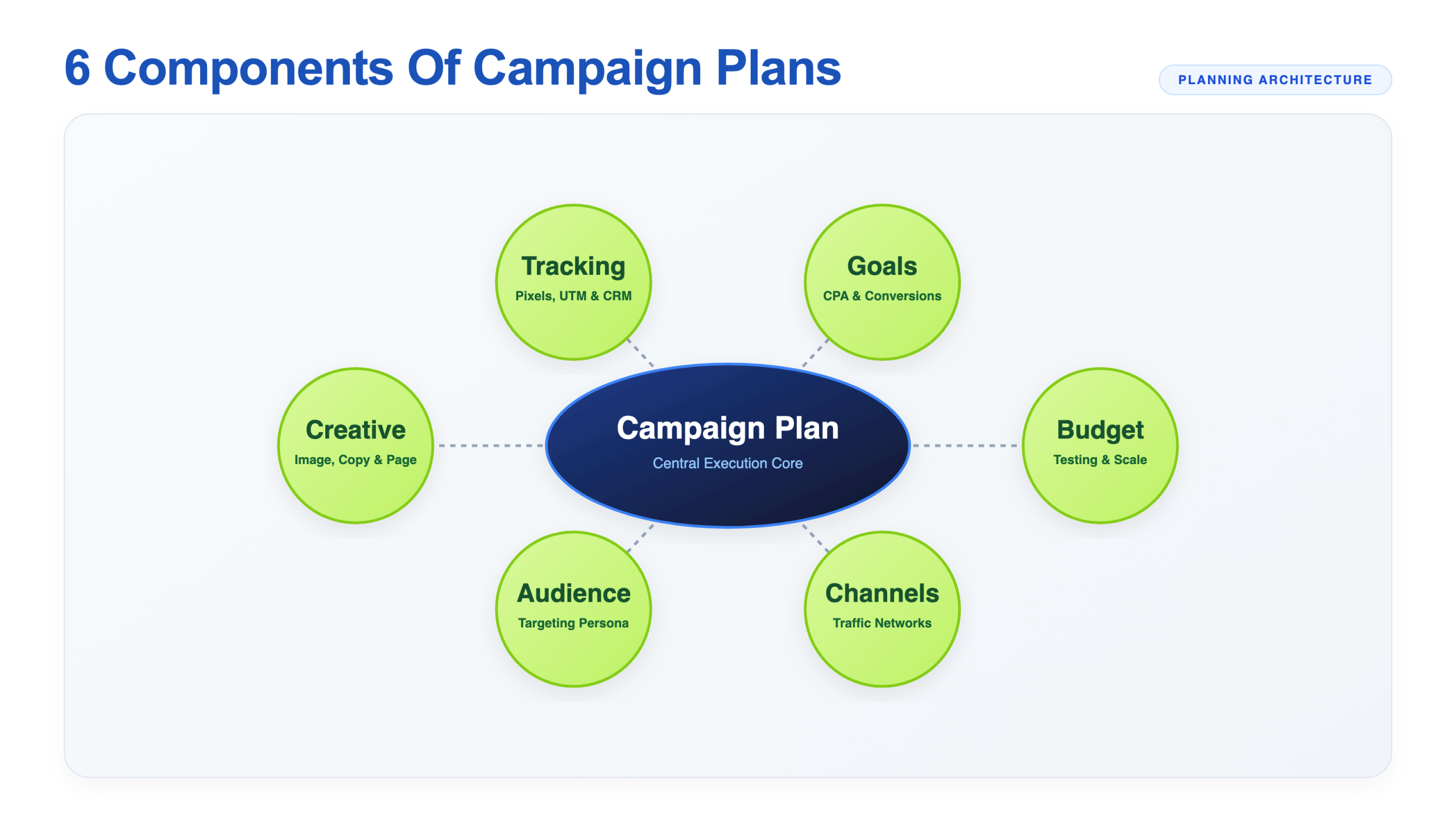
To give quality instructions that outsmart the algorithm, every campaign must be fully blueprinted across six pillars before creating a single draft in your ad manager.
Ad networks are publicly traded corporations designed to maximize revenue per user. If you give ambiguous instructions, their algorithms will distribute your impressions to cheap, accidental mobile clicks and low-intent audiences. Your campaign plan is your protective boundary.
3. The 6 Pillars of a Proper Campaign Plan
Across Section 6, the instructor methodically details the six non-negotiable components that turn paid traffic into a predictable acquisition machine:
Pillar 1: Setting Your Goal
As established in Traffic Trap #4, you must define the single independent variable for this specific campaign:
"The first component of the campaign planning process is setting your goal. What is the single action we want people to take? Is it an opt-in? Is it a tripwire sale? By locking in one quantifiable milestone, you know exactly what your target cost per action (CPA) needs to be."
Pillar 2: Quantifying Your Test Budget
Do not guess your daily ad spend. Paid media testing is a mathematical purchase of statistical confidence:
"The second component of your campaign plan is your test budget. After all, this is paid traffic! You have to determine what you are willing to spend to test your thesis. We calculate test spend based on the expected cost to acquire a customer, ensuring we have enough statistical volume to evaluate whether an ad variation is truly a winner or a loser."
Pillar 3: Channel Selection
Pick the platform that matches your prospect's stage of awareness:
"The third component of your campaign plan is your channel selection. This is a really important step. You have to ask: Where are my ideal customers right now, and what mindset are they in? If they have high intent and are actively searching for solutions, Google Search is unbeatable. If they are problem-aware and browsing visually, Meta or YouTube will produce superior results."
4. Translating Personas to Platform Targeting (Pillar 4)
One of the sharpest insights in Section 6 is the distinction between a customer persona and an Ad Persona:
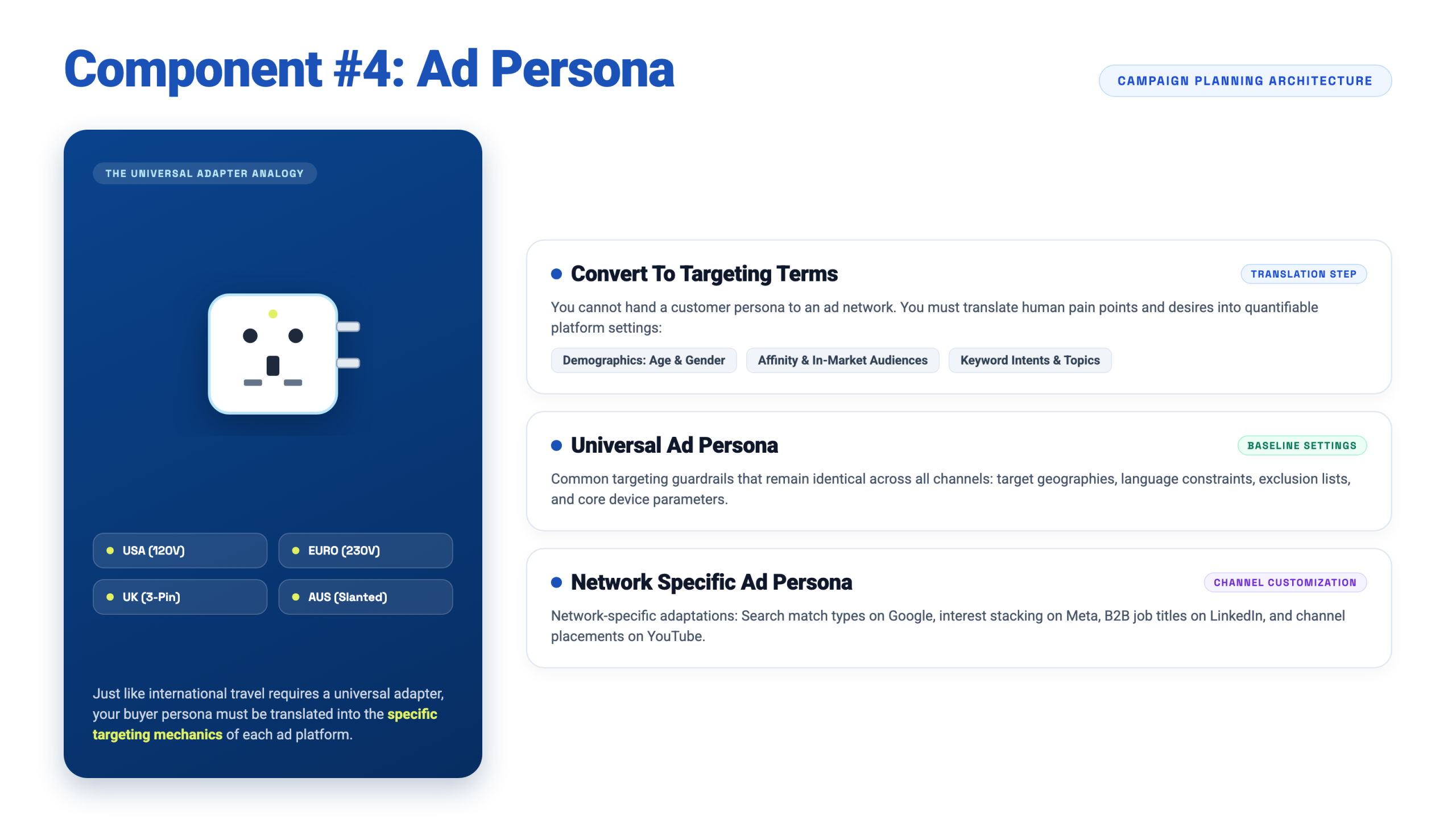
"The fourth component of your plan is determining your ad persona. Back in the customer research section, we showed you how to create customer personas. But you can't just hand that piece of paper to an ad network and say: 'I want to target these people.' You have to figure out how to translate those human desires into targeting terms: demographics, content categories, keywords, placements, and interests."
The Universal Adapter Analogy
The instructor uses a travel electrical adapter to explain network-specific targeting:
"Every country has different electrical outlets, and every ad network has different targeting mechanics. You have to translate your customer understanding into the specific settings of the network you are buying on. We use our Ad Persona worksheet to check off the boxes: demographics, affinity audiences, keyword intents, and device exclusions: so we hedge our bets before spending a single dollar."
Pillar 5: Creative Architecture
Creative is the delivery vehicle for your pitch:
"The fifth component of your campaign plan is your creative. This is where you bring the emotions and hooks from your empathy map to life. You plan out your image styles, your video angles, and your headlines in advance, testing high-contrast variations to see what stops the scroll."
Pillar 6: Tracking & Parameter Verification
The final safeguard before launch:
"The sixth and final component of your campaign plan is tracking. Honestly, this is where most people get lazy. You have to generate all of your UTM links, confirm that your analytics goals fire, and verify tracking persistence before turning on spend."
5. The Discipline of Pre-Planning: Simple, But Not Easy
The instructor concludes Section 6 with a sobering reminder regarding operational execution:
"There you have it: the six pieces of a proper campaign plan. Once again: extremely simple, but not easy! It requires upfront effort to sit down and document each piece before you touch the ad manager. But when you do this, you eliminate emotional decision-making, prevent costly mistakes, and set your business up for profitable, repeatable scaling."
6. Digital Advocators Members-Area Tool: The Campaign Planning Blueprint
To ensure you never launch another ad campaign without an airtight roadmap:
- Tool Name: The 6-Pillar Campaign Planning Architecture Blueprint
- Purpose: A comprehensive pre-flight worksheet that calculates your statistical test budget, translates customer personas into platform targeting settings, and verifies tracking before launch.
- Access: Available inside your Digital Advocators Member Portal.
