1. The Core Philosophy: The Nesting Doll Principle
Great media buying is not about constant tinkering. It is about building an intuitive structure where you can open your dashboard, look at the screen for thirty seconds, and immediately understand what is happening.
In the opening moments of the training, the instructor introduces the foundational mental model for all campaign organization:
"I like to think of campaigns kind of like wooden nesting dolls. Basically, your campaign structure just gives you a logic in which to set up your campaigns, look at them in shells, and know what is going on."
Picture a classic wooden nesting doll:
- The Outer Doll (The Campaign Level): Defines your overall strategic objective, bidding model, and primary campaign focus.
- The Middle Shell (The Ad Group or Ad Set Level): Isolates one specific targeting variable, such as a distinct age bracket, a contextual topic, or an interest theme.
- The Inner Doll (The Ad and Asset Level): Contains your actual creative variations, video hooks, or specific search keywords.

When your campaigns are structured in distinct shells, you never have to guess why costs are rising. If one demographic or keyword theme underperforms, you simply open that shell and shut down the single underperforming cell while leaving the profitable cells running uninterrupted.
2. The Dangerous Trap: Lumping Everything into One Bucket
The biggest mistake amateur advertisers make is following the default recommendations of platform sales representatives.
"I know the reps in Google, a lot of times they will just call a campaign 'Audiences' and just load up a whole bunch of audiences in there. I like to focus on one audience at a time, because I know these audiences are pretty big and they can serve a lot of impressions."
When you lump five different audiences, three age brackets, and both genders into a single ad group or ad set, you surrender control to the delivery algorithm:
- The algorithm quickly finds the path of least resistance, pouring eighty percent of your budget into the cheapest clicks rather than the most qualified buyers.
- Younger age brackets might eat all your daily impressions because they spend more time scrolling, while the older demographics that possess the purchasing power to buy your premium services get starved.
- You cannot see which specific targeting slice generated your sales without digging through complex secondary breakdown reports.
3. Structure Model 1: The Audience Campaign (The Broad Ocean)
The first structural model demonstrated in the training is the dedicated Audience Campaign.
In this example, the campaign focuses on a single major stock audience: In-Market for Advertising and Marketing Services. Instead of leaving all demographic groups mixed together, the instructor breaks the ad groups down by individual age brackets:
├── Ad Group 1: Males | Ages 25 to 34
├── Ad Group 2: Males | Ages 35 to 44
├── Ad Group 3: Males | Ages 45 to 54
├── Ad Group 4: Males | Ages 55 to 64
└── Ad Group 5: Males | Ages 65+
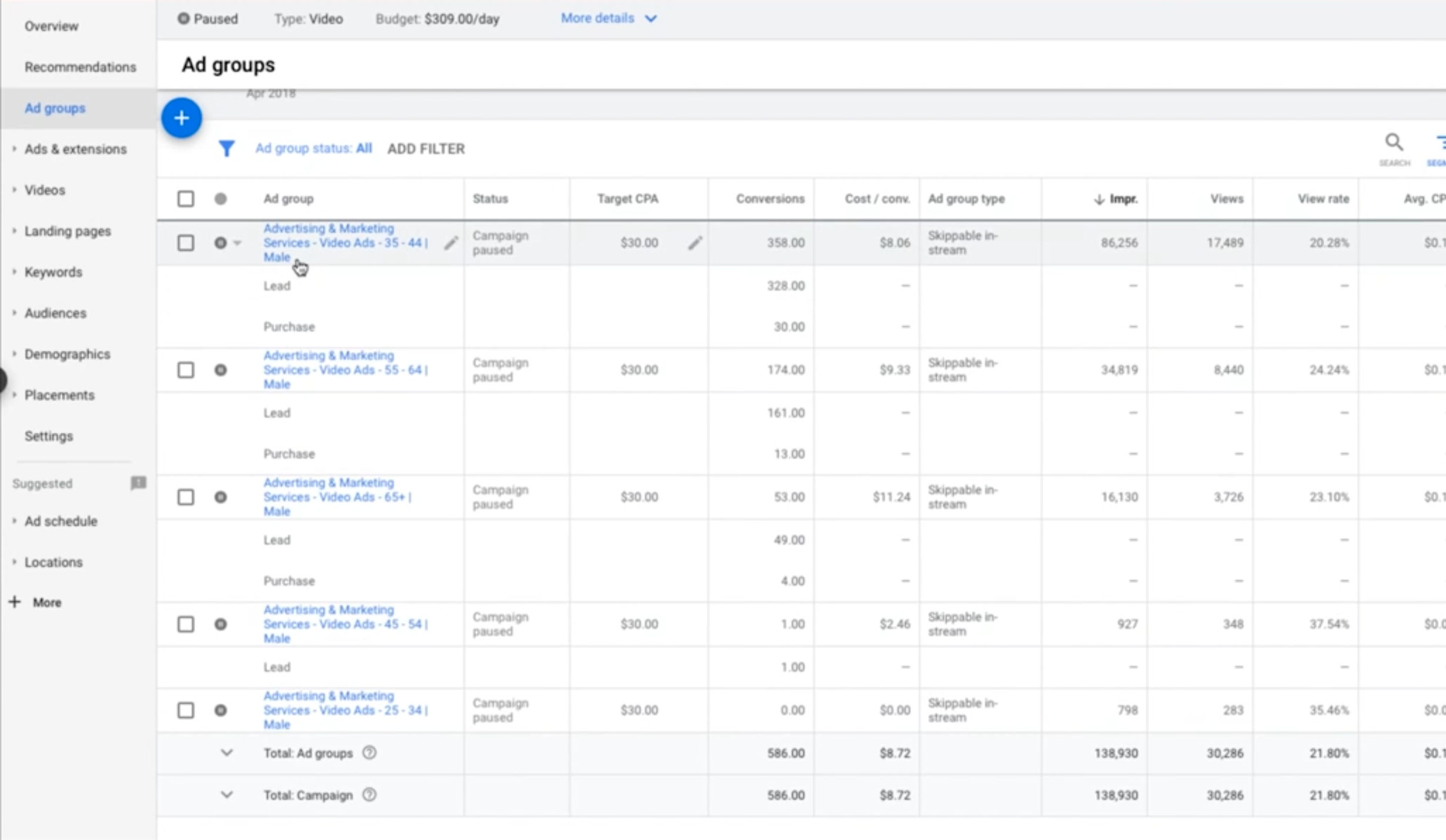
Why Age Group Shells Win
By isolating each age bracket into its own shell, you create transparent performance cells:
- In the instructor's investing and trading business, historical data proved that audiences aged 55 and up consistently produced the highest conversion rates and lowest cost per acquisition.
- By isolating age groups, they could immediately observe whether the 25 to 34 shell was lagging behind in purchase volume.
- If an age group fails to hit key performance targets, you pause that single ad group. Your budget instantly concentrates into the winning demographic cells without resetting the overall campaign learning phase.
4. Structure Model 2: The Contextual Topic Campaign
The second structural model tackles contextual placements and broader affinities.
In the masterclass, the instructor shares a valuable discovery: people searching for Self-Help and Motivational content convert surprisingly well for professional education and marketing webinars.
Rather than mixing motivational topics into his audience campaign, he creates a separate, dedicated Topic Campaign:
├── Ad Group 1: Topic Placement | Ages 35 to 44
├── Ad Group 2: Topic Placement | Ages 45 to 54
└── Ad Group 3: Topic Placement | Ages 55+
When analyzing the initial data, the instructor spotted an immediate trend: the 45 to 54 bracket was underperforming on front-end purchases compared to the 55 and older bracket.
Because the shells were isolated, he did not have to wonder if the creative was failing or if the landing page was broken. The answer was right on the surface: the 45 to 54 shell was dead weight. Pausing that single cell immediately improved overall campaign return.
5. Structure Model 3: The Intent and Keyword Campaign (The Lake vs. The Ocean)
Here the instructor shares one of the most powerful analogies in the entire AdSkills training library: The Lake versus The Ocean.
🌊 THE BROAD OCEAN (Audience Campaigns)
- Massive impression volume
- Broad demographic reach
- Requires universal mass appeal
- Higher initial cost per acquisition
- Potential for immense scale
🎣 THE TARGETED LAKE (Keyword Campaigns)
- Tightly constrained impression volume
- Laser-focused search intent
- Converts specialized problem solvers
- Lower cost per sale and cheaper leads
- Consistent, highly profitable returns
"Audiences, I look at them as being a much larger body of water, it is an ocean with many more impressions available. Your offer has to have some type of larger mass appeal to do well there. Keywords are a smaller lake. They will not scale as large as audiences, but I have had campaigns where no audiences worked at all, and I was still able to make keywords work."
When you launch a new offer, you may discover that your messaging does not yet possess the universal appeal required to win in the broad ocean of mass audiences. If that happens, move from the ocean into the lake: launch a dedicated keyword or high-intent search campaign where prospects are actively looking for specific solutions.
Grouping by Keyword Themes
Inside an intent campaign, you group ad groups by thematic categories:
- Competitor and Tool Themes: Targeting people searching for specific software platforms or industry tools (for example, searches for "ClickFunnels" or specific funnel builders).
- Opportunity and Problem Themes: Targeting general topical terms (such as "make money online" or "generate qualified leads").
- Industry Authority and Guru Themes: Targeting people searching for well-known authors, educators, and thought leaders in your space.
6. The 3-Tier Diagnostic Scanning Method: How to Read Your Dashboard
The real beauty of the nesting doll architecture is that it turns optimization into a simple, three-step morning routine.
Tier 1: The Campaign Level (Bird's Eye View)
Look at your campaign row. Check your overall cost per acquisition and return. Is the campaign healthy as a whole? If yes, leave the top level alone.
Tier 2: The Ad Group or Shell Level (Finding Dead Weight)
Click into the campaign and inspect your individual shells (age groups or keyword themes). Shut down shells that spend budget without sales. Protect shells hitting target metrics.
Tier 3: The Asset Level (Extracting Gold Nuggets)
Punch into winning shells to look at individual keywords or creative variations. Often, eighty percent of success is driven by one or two specific assets. Extract those phrases for your copy.
7. Platform Translation: Applying the Framework to Meta Ads Manager
While the instructor demonstrates inside Google and YouTube, the exact same nesting doll logic applies directly to Meta Ads Manager (Facebook and Instagram).
Outer Doll: Google Campaign = Meta Campaign (Sets Objective & Budget)
Middle Shell: Google Ad Group = Meta Ad Set (Isolates Targeting, Ages & Interests)
Inner Doll: Google Video/Keyword = Meta Ad Creative (Isolates Hooks, Visuals & Copy)
How to Structure a High-Converting Meta Campaign
├── Ad Set 1: Broad Demographic Shell (e.g. Ages 35 to 55 | Top Metro)
├── Ad Set 2: High-Intent Interest Shell (e.g. Specialized Tools/CRM)
└── Ad Set 3: Warm Retargeting / Lookalike Shell (Engagers & Visitors)
- Avoid the Meta Rep Trap: Do not turn on Advantage+ audience expansion and throw twelve unrelated interests into one ad set. Keep your ad sets distinct.
- Isolate Your Targeting Angles: Give your broad demographic audience its own ad set, your tool/software interest its own ad set, and your custom warm audiences their own ad set.
- Prune the Dead Weight: If your broad interest ad set is driving cheap clicks that never convert on your booking page, pause that ad set. Let your budget flow to the high-intent authority audience.
8. Summary Checklist: The Campaign Structure Audit
Before spending your next media dollar, run your accounts through this verification checklist:
- [ ] Does every campaign have one clear, singular focus? Are you avoiding mixed objective and mixed audience chaos?
- [ ] Are your ad groups or ad sets organized into logical shells? Did you separate distinct age brackets, distinct keyword themes, or distinct interest categories?
- [ ] Can you identify dead weight in under thirty seconds? If one demographic is burning cash without sales, can you pause it without harming your other ad sets?
- [ ] Are you balancing the ocean and the lake? If your offer is not converting on broad mass audiences, have you tested specialized, high-intent keyword or tool themes?
- [ ] Are you inspecting down to the asset level? Do you know the exact two or three gold nugget creative hooks or search queries driving the bulk of your revenue?
