Your Dream Customer and Congregation Architecture: Moving Away From Pain, the Anti-Avatar, and the Opportunity Switch
Field notes and direct-response masterclass breakdowns on audience acquisition and conversion architecture. How to eliminate the "Zanos" algorithm trap, define your dream avatar and anti-customer, leverage the two core motivators, and architect an irresistible opportunity switch.
Most entrepreneurs fail at paid media and customer acquisition because they approach the market backward. They log into ad managers, obsess over technical targeting buttons, and tweak algorithm bids before answering the most foundational direct-response question in commerce: Who is your dream customer, who is your anti-customer, what acute pain are they running away from, and where are they already gathered right now?
If you do not possess microscopic clarity on the exact human beings you are called to serve, you cannot write converting ad copy, you cannot craft irresistible bait, and you will inevitably attract clients who drain your sanity and destroy your company. This masterclass rebuilds your marketing engine from first principles.
- The Tactical Trap and "Zanos" Algorithm Snap: Why media buyers who rely on temporary loopholes get wiped out, and why relationship architecture is the only permanent defense.
- Being vs. Doing (The Myron Golden Protocol): Why knowing what to do never produces transformation until you take psychological ownership of the result before you know the path.
- The Dan Sullivan "Who Not How" Shift: How procrastination begins when operators ask "How do I do this?" instead of "Who knows how to do this?"
- Defining the Dream Customer vs. Anti-Avatar: The painful reality of hating your customers, the Eben Pagan image exercise, and Perry Belcher's "Who Is Julie?" retail breakthrough.
- The 2 Human Motivators (Pain vs. Pleasure): Why 99% of mass cold audiences buy strictly to escape acute suffering, and why ambitious entrepreneurs mistakenly write pleasure copy that flops.
- The Opportunity Switch vs. Improvement Offer: Why improvement offers force prospects to admit failure, why an opportunity switch absolves guilt, and how to avoid marketing schizophrenia.
- The RFM Value Score & Porcupines in Heat: Recency, Frequency, Monetary data scoring, the biological buying window of acute pain, and why primary social emails are worth 80x more.
1. The Tactical Trap and the "Zanos" Algorithm Snap
Entrepreneurs love tactics because tactics promise effortless shortcuts. They log into an ad platform, discover a temporary targeting loophole, make fast revenue, and mistakenly believe they have built an enduring enterprise.
Direct-response veterans know better. Platform tactics change constantly; fundamental human psychology never changes. The instructor illustrates this platform cycle through direct personal history:
"I have been in this game for 15 years now. When I first got started, there was this magic site called Google. Everything was amazing. You could throw up simple landing pages, rank effortlessly, and print money. Then the storm came.
Think about Thanos in the Avengers movies. Thanos goes around collecting all the Infinity Stones. His goal is to eliminate half the universe because he believes resources are scarce. He gets all the stones in his glove, snaps his fingers, and half the population instantly turns to dust.
That is exactly what Google did with the original Google Slap. Companies with an $18 billion annual advertising budget who were not tracking direct response survived; everyone else was wiped out overnight. For two or three years, almost everyone I knew in internet marketing was completely unemployed.
Then Facebook came along. It has been amazing, easy, and one of the greatest gifts to our community. But Mark Zuckerberg has Thanos's glove now. We call him 'Zanos.' At any minute, an ad network can snap its fingers and wipe out half the businesses in the marketplace.
The difference between those who survive across decades and those who vanish is simple: survivors do not rely on platform tactics. Survivors master the overarching direct-response strategies of human attention, congregation discovery, and relationship architecture."
If you understand how human beings congregate, what emotional fires they are trying to put out, and how to capture their attention ethically, you are protected regardless of which platform rises or falls.
2. Being vs. Doing: The Myron Golden Decision Framework
Before configuring a single ad campaign or sketching a funnel, you must confront the internal communication gap that prevents 95% of entrepreneurs from succeeding.
Direct-response keynote speaker Myron Golden delivered a profound presentation on the stage illustrating why information alone does not produce transformation:
"Knowing what to do does not give you the ability to do it. The communication gap between people who are successful and people who struggle is that mentors talk about how to BE the person who achieves the result, while students listen only for WHAT TO DO. Every time the mentor explains the mindset of ownership, the student translates it into an item on a to-do list and says, 'I don't get it.'
In the book You Squared by Price Pritchett, the central thesis is clear: people who succeed are not trying to succeed any more than people who fail are trying to fail. Success and failure are both automatic once your internal identity is set. You must become the person who takes full ownership of the result before you know how you are going to accomplish it."
Myron dismantled three common clichés that destroy business owners:
- Myth 1: "Time is money." Time is NOT money. Time is finite, irreplaceable, and non-renewable. If you believe time is money, you will trade huge blocks of your irreplaceable life for small amounts of other people's cash.
- Myth 2: "People hate to be sold." People love to buy, and people love to be sold! What people hate is being convinced. Convincing is attempting to get someone to do something for your reasons. Persuasion is helping someone make a decision they already desire to make for their own reasons.
- Myth 3: "Three birds decide to fly away, so three are left." If two birds truly decide to fly, there is only one bird left on the fence! The word decide originates from the Latin root caedere (the same root as homicide and suicide), meaning to cut off. When you make an authentic decision, you cut yourself off from every other alternative.
3. The Dan Sullivan Protocol: Who Not How
The moment entrepreneurs encounter a technical challenge in media buying: such as pixel setup, video editing, or landing page scripting: they fall into an operational paralysis trap.
"We set a massive vision and begin moving forward. Suddenly, we hit an obstacle and ask: 'HOW do I do this?' That single question triggers an immediate, horrible loop of procrastination. You sit at your desk, overwhelmed, trying to learn software, coding, copywriting, and media management all at once.
The magic question is never 'How do I do this?' The question is: 'WHO knows how to do this?'
When you find the Who, you never have to waste months learning the How. The Who already possesses the skill, has already made the mistakes, and can execute your vision in days rather than quarters.
People complain: 'Russell, I am broke. I cannot afford to hire top-tier developers or copywriters.' That is an excuse. When I was a broke college student and my wife was making $9.50 an hour, I could not afford to pay high salaries either. But if you cast a compelling, authentic vision, the right Whos will rally around you. You can offer equity, revenue-shares, joint ventures, or reciprocal skill trades. Motion attracts talent."
4. Defining Your Dream Customer vs. The Anti-Avatar
The foundational secret of direct response begins with identifying your avatar. Most companies create products first and search for buyers second. The correct architecture begins with identifying the human being you wish to spend your life serving.
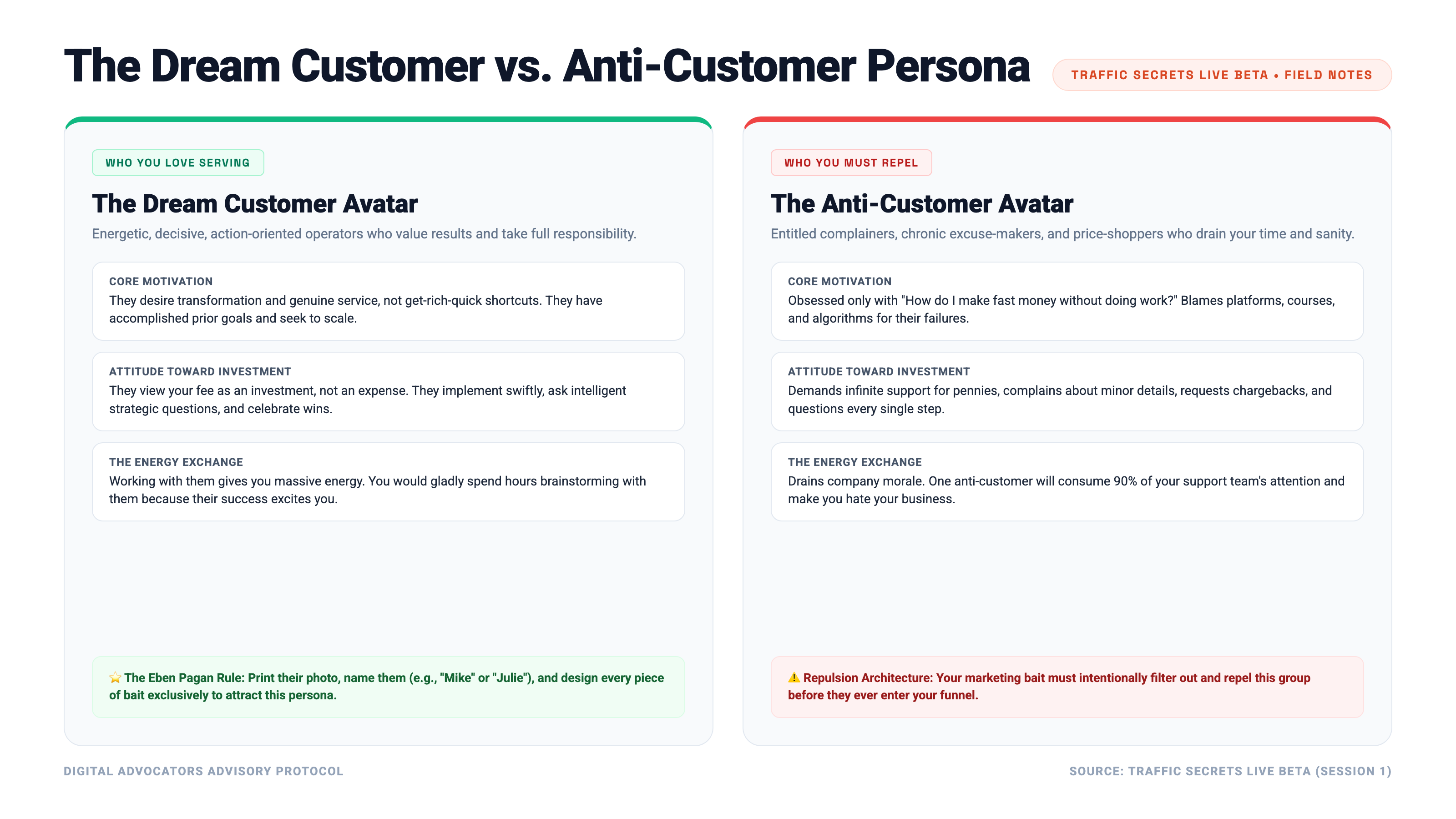
The instructor shared the raw emotional origin of this framework:
"Eight or nine years into running my company, I woke up one morning with a sick feeling in the pit of my stomach. Our business was doing millions in sales, but I realized something horrifying: I hated my customers.
They were needy, entitled, constantly complaining, demanding refunds, and blaming our tools for their laziness. I literally sat in bed wondering if I should shut the entire company down and walk away.
Around Christmas, Tony Robbins released a video from his resort in Fiji. He said something that pierced my soul: 'If you don't like your relationship, change it. If you don't like your body, change it. If you don't like any part of your life, just change it.'
Right around that time, direct-response educator Eben Pagan taught a training on customer selection. He said: 'The fastest way to transform your business is to change who you choose to serve. Go to Google Images, give your avatar a name, list their personal attributes, print out their photo, and tape it next to your monitor.'
I realized that my marketing bait had been attracting opportunists who wanted easy cash. I made a solemn vow: I would only market to dream customers."
The Perry Belcher "Who Is Julie?" Retail Breakthrough
To demonstrate how enterprise businesses use this concept, the instructor recounted an iconic story featuring direct marketer Perry Belcher:
"Years ago, Perry Belcher invested $50,000 into manufacturing liquid candles. It was a disaster: the liquid was dangerously flammable, and they could not sell them safely. But his chemist partner discovered that if you washed your hands with it, it functioned as an incredible antibacterial soap. That formulation eventually became the foundation for modern hand sanitizer brands like Purell.
Perry flew to New York to pitch the product to the retail executives at Bed Bath & Beyond. He walked into the boardroom and delivered his pitch.
The executives listened, leaned back, and said: 'We like the product, but we don't think Julie would like the packaging.' Perry adjusted his pitch. They responded: 'Julie wouldn't purchase that price point.'
Perry slammed his notebook down and asked: 'Who in the world is Julie? Can we please just get Julie into this room so I can talk directly to her? She sounds like the decision-maker!'
The executives laughed and pulled out a framed binder. Julie was their target customer persona: a 38-year-old suburban mother with two children, driving a minivan, managing the family budget, and valuing health and cleanliness. Every single purchasing decision, store layout, and promotional flyer at Bed Bath & Beyond was filtered through one question: Would Julie buy this?"
| Dimension | The Dream Customer Avatar | The Anti-Customer Avatar |
|---|---|---|
| Primary Motivation | Personal transformation, genuine mastery, serving others, and long-term legacy. | Get-rich-quick schemes, finding shortcuts, and getting something for nothing. |
| View of Investment | Views your price as an investment that yields massive ROI when executed diligently. | Views your fee as a cost, haggles over pennies, and demands unconditional guarantees. |
| Personal Responsibility | Takes 100% radical ownership of their outcomes. Solves problems proactively. | Blames software, coaches, economy, algorithms, and circumstances for lack of results. |
| Operational Impact | Inspires your team, produces glowing case studies, and ascends seamlessly into premium tiers. | Consumes 90% of customer support bandwidth, threatens chargebacks, and demoralizes staff. |
| Strategic Action | Attract: Craft specialized bait and high-status value propositions exclusively for them. | Repel: Intentionally insert negative qualifiers into ads and sales copy to filter them out. |
5. The Two Core Human Motivators: Pain vs. Pleasure
Every buying decision made by a human being on earth is driven by one of two forces: moving away from pain or moving toward pleasure.
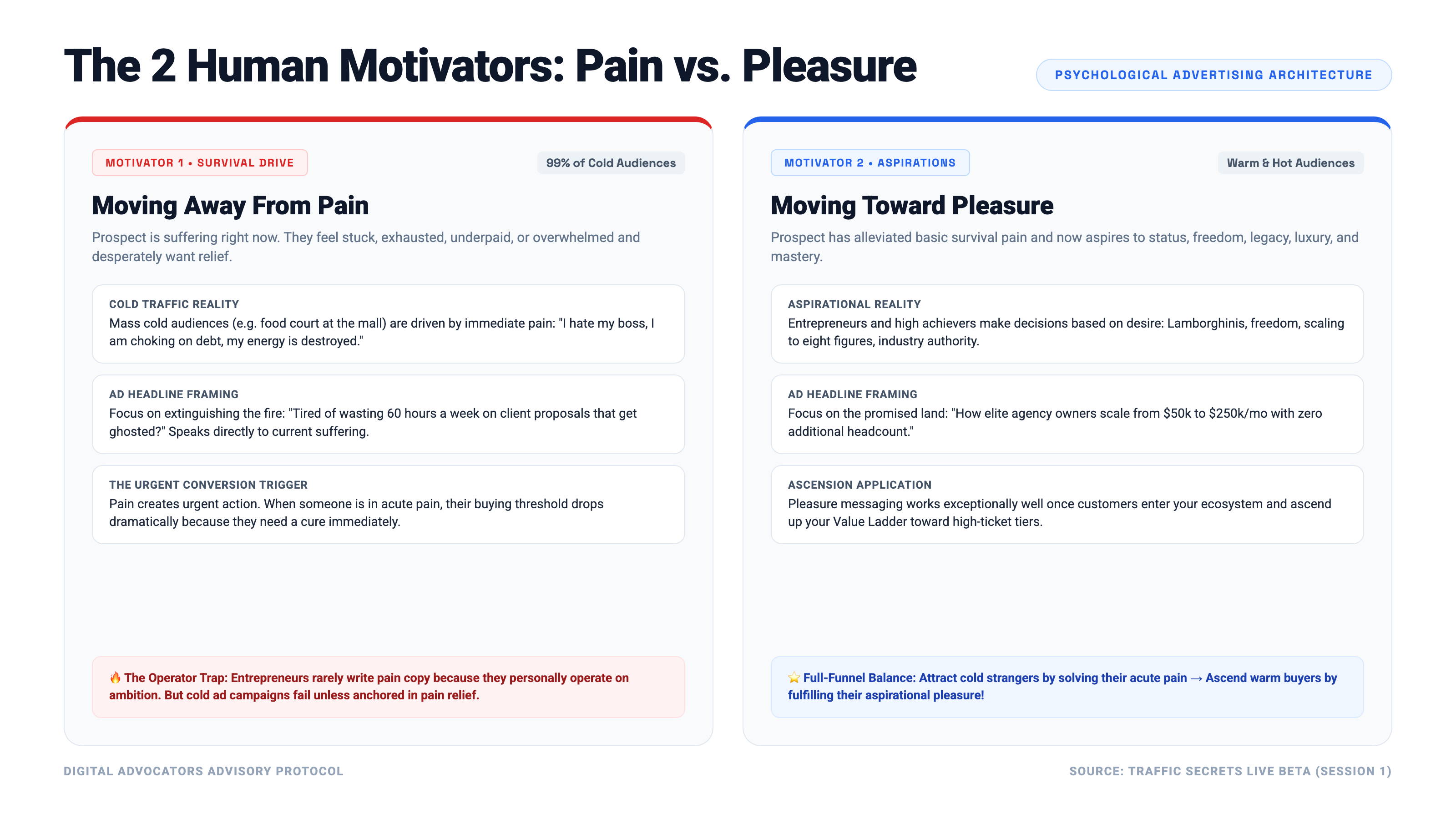
The most fatal mistake made by ambitious marketers is assuming that prospects think like they do:
"Look at human psychology. Why do people buy?
1. They are in acute pain and want to get out of it.
2. They feel comfortable and want to move toward pleasure, status, or luxury.
Entrepreneurs make decisions moving toward pleasure: they dream of Lamborghinis, freedom, impact, and eight-figure exits. Because entrepreneurs operate from aspiration, they instinctively create ads and landing pages that preach pleasure: 'Achieve your dream lifestyle!' or 'Build an empire!'
But if you walked into the food court at an average shopping mall today, 99% of the people sitting there are NOT thinking about Lamborghinis. They are thinking about PAIN.
Their back hurts. They are terrified they cannot pay rent on Friday. They despise their boss and dread walking into work on Monday morning. Their marriage is strained under financial pressure.
When people are in acute pain, their buying resistance collapses. They need relief immediately. If your cold traffic ad speaks to their pain, they stop their scroll and raise their hand. If your ad speaks only to aspirational luxury, they scroll right past."
6. The Opportunity Switch vs. The Improvement Offer
Once you have identified your dream customer and diagnosed their acute pain, you must present your solution. This is where most marketing fails: they present an improvement offer instead of an opportunity switch.
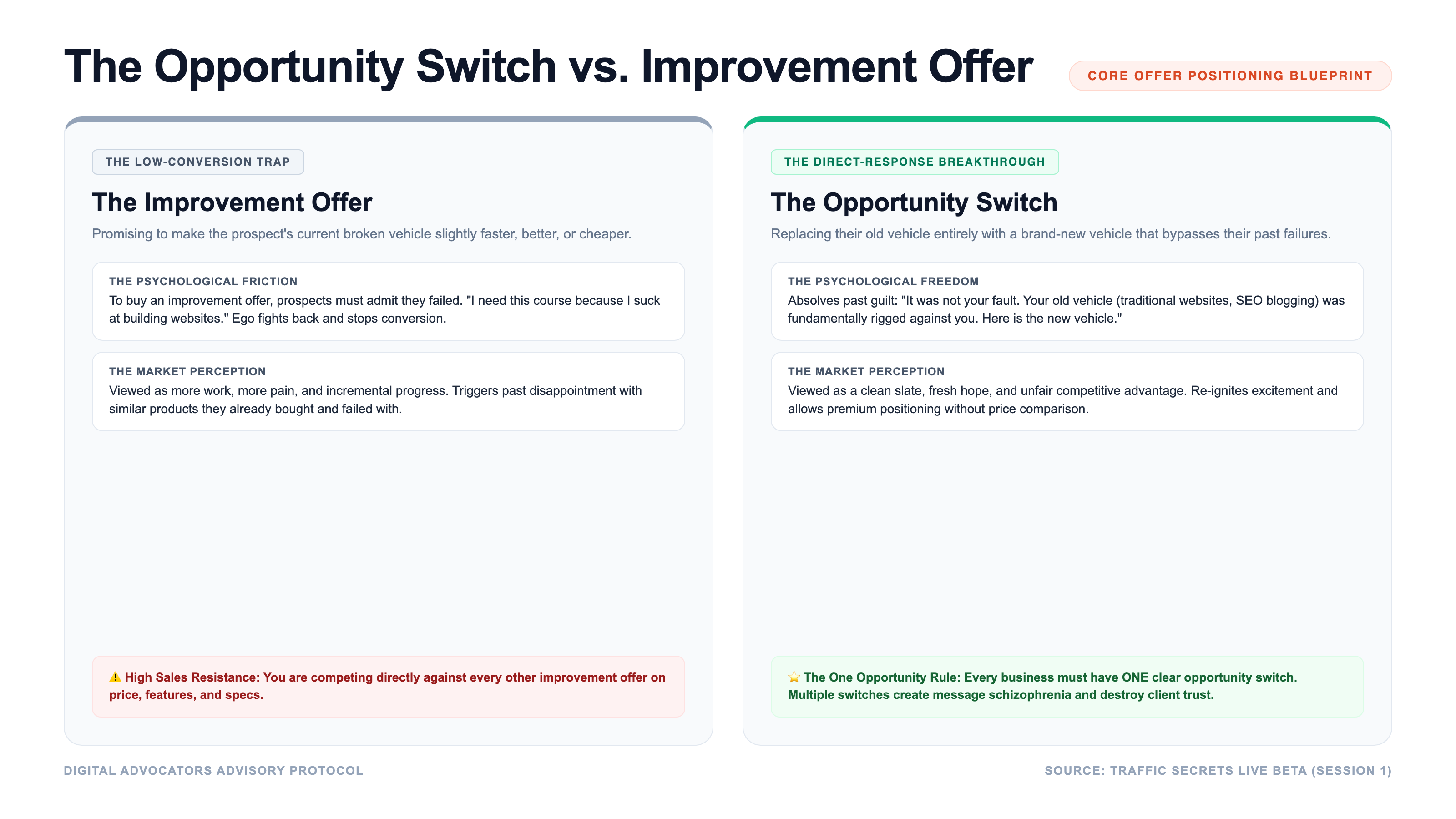
An improvement offer promises to make the customer's existing vehicle slightly better, faster, or cheaper (e.g., "A better way to build WordPress websites" or "How to improve your cold-calling close rate"). The instructor breaks down the psychological friction:
"The fundamental problem with improvement offers is human ego. For a prospect to buy an improvement offer, they have to privately admit to themselves that they are a failure.
If I sell a course called 'How to write better sales copy,' the buyer must admit: 'I suck at copywriting, and I have failed.' That triggers deep psychological defense mechanisms. Furthermore, improvement offers remind prospects of past pain: every other course or tool they previously bought in that category that failed to work.
An Opportunity Switch completely bypasses that resistance. With an opportunity switch, you say:
'It was not your fault. You didn't fail because you were bad at building websites; you failed because traditional websites are fundamentally dead. The vehicle itself was flawed! Step out of that broken car and step into this brand-new vehicle called a Sales Funnel.'
An opportunity switch wipes the slate clean. It absolves past guilt, eliminates past trauma, and presents a completely new opportunity that cannot be compared to competitors."
7. The RFM Value Score and the "Porcupines in Heat" Principle
How do direct-response companies identify their highest-value buyers and segment their audience for maximum lifetime value? The answer dates back decades to pre-internet direct mail: the RFM Score.
"Direct mail legends discovered that a person who purchased something today is dramatically more likely to buy another product tomorrow than someone who purchased six months ago. We call this the Porcupine in Heat Principle.
When porcupines are in heat, they experience a biologically intense, acute two-week window where they mate continuously. Once that short window closes, they are completely done for the year.
Human buyers operate the exact same way when they are in acute pain!
Years ago, I took our company bowling. I showed up with my custom ball and shoes, and someone on our team beat me badly. I was so upset and in so much emotional pain that night. I went home and turned into a porcupine in heat!
In a 48-hour window, I bought a new custom reactive-resin bowling ball, professional bowling shoes, wrist supports, instructional video courses, and books on ball drilling physics. Two weeks later, all these packages arrived at our house. My wife looked at the pile and asked: 'Why did you buy all this? We never go bowling!'
The acute pain had passed! If you had attempted to sell me bowling equipment three weeks later, I would not have spent ten cents. But during that 48-hour window of acute pain, I bought everything in sight. When a prospect enters your world, capitalize on their active buying window immediately."
Direct-response pioneer Jeremy Shoemaker ("Shoemoney") audited hundreds of millions of commercial emails and uncovered an eye-opening metric: A prospect who registers using their primary, verified identity email (such as their active social account email) is worth 80 times more in lifetime revenue than a user who submits a temporary, secondary throwaway inbox. High-converting funnels must prioritize acquiring primary contact data over raw volume.
8. Step-by-Step Implementation Roadmap
To execute the teachings of Session 1 execute this operational sequence:
- Step 1: Draft the Pro-Avatar Profile: Select a descriptive name for your avatar (e.g., "Marcus" or "Elena"). Go to Google Images and search for portrait photographs that visually represent this person. Print out the photo and place it at your workstation. Answer what prior goals they have achieved that prove they possess work ethic.
- Step 2: Draft the Anti-Avatar Negative Qualifier List: List the 5 personality traits and behaviors you will NOT tolerate in your business. Draft explicit negative qualifying statements for your ad copy and landing page footers.
- Step 3: Complete the Pain vs. Pleasure Audit: List the 10 acute, daily frustrations your avatar experiences right now. Use their raw language patterns ("stuck in proposal hell," "terrified of payroll"). Then list the 5 aspirational milestones they wish to celebrate once the pain is resolved.
- Step 4: Articulate Your Single Opportunity Switch: Identify the old, broken vehicle your market has been struggling with. Define your new vehicle in one concise declaration: "You do not need [Old Broken Method]. What you need is [New Opportunity Vehicle]."
