In Section 4 of the AdSkills Traffic Traps masterclass, the instructor tackles one of the most pervasive yet ignored causes of failed advertising campaigns: Traffic Trap #4: Unclear Goals.
When campaigns attempt to achieve multiple outcomes at the same time: asking a cold visitor to watch a video, read three case studies, subscribe to a newsletter, and book a consultation call all in one visit: the prospect experiences cognitive paralysis. Even worse, the media buyer loses all ability to measure what is working.
1. The Pointless Meeting Parable
To capture the frustration of muddy objectives, the lesson opens with an experience every professional dreads:
"Have you ever been in a meeting and felt like this guy after 30 minutes, asking yourself: 'Why do we even have this meeting in the first place?' Well, we have. And that's why whenever we have meetings, there have to be clear goals as to why we're meeting. Otherwise, it's just a waste of everyone's time."
Yet despite knowing how demoralizing a pointless meeting feels, advertisers do the exact same thing to their prospects:
"While everyone has experienced this, we found most marketers never apply these lessons to their marketing. They either have long-winded copy with no point, or they want people to take five actions at once. Lack of focus and complexity are the two enemies of action, and that's why traffic trap number four is having unclear goals."
2. The Two Enemies of Action & The Core Rule
In direct response media buying, world-class performance comes down to radical simplicity:
"In the world of direct response marketing, laser focus is the one thing that separates the best in the business from the Average Joes. The champs know that complexity is the enemy of action."
This conviction forms the golden rule taught at AdSkills:
"Our rule here at AdSkills is: If it's complicated, it's wrong."
It takes deliberate effort and discipline to distill your marketing down to a simple, singular action. But when you do, your conversion rates skyrocket because prospects immediately understand what is expected of them.
3. Pillar 1: Customer Clarity, the Brain, and the $10M Statue
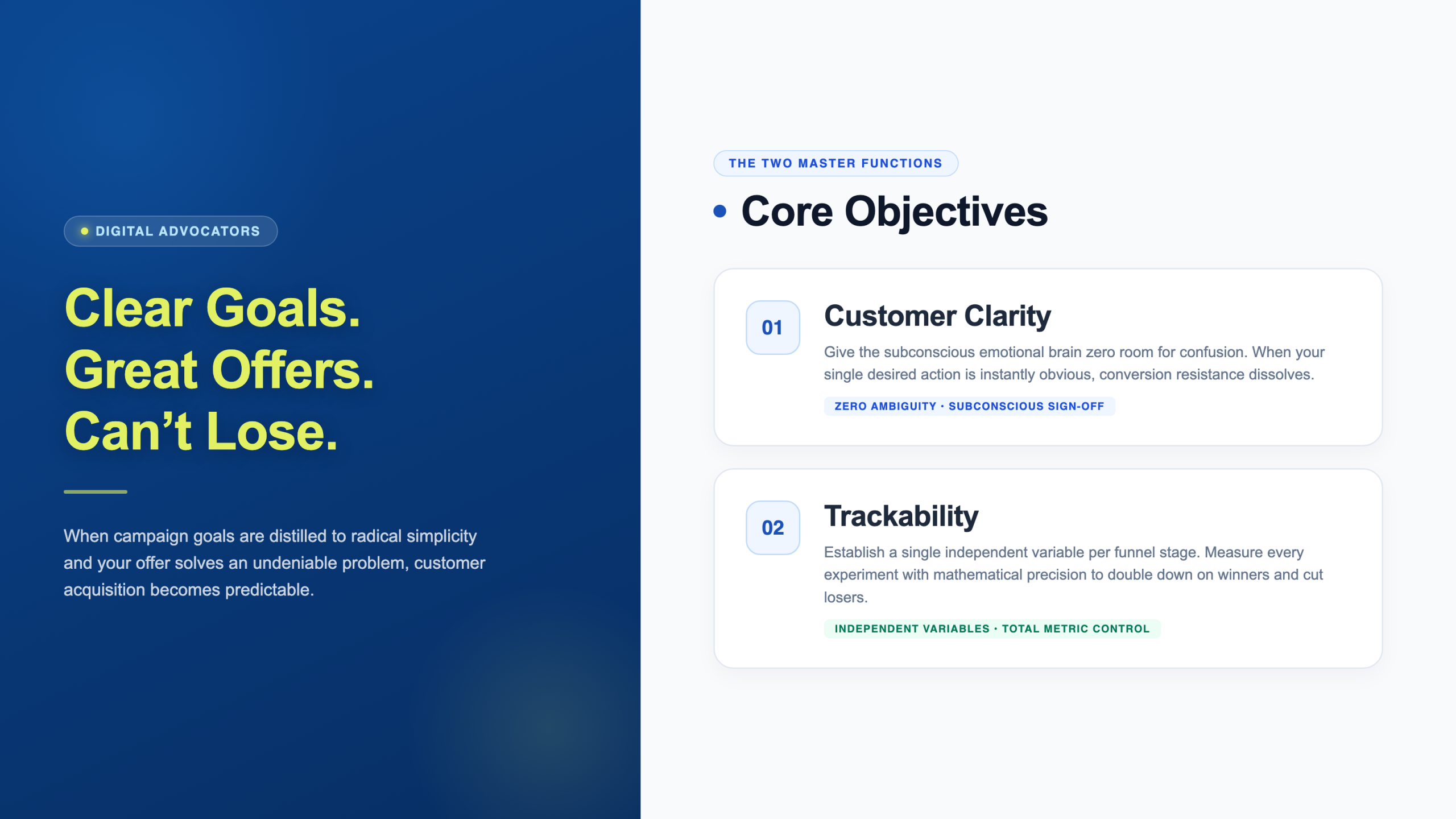
The instructor explains that setting clear goals serves two master functions: Customer Clarity and Trackability.
When addressing customer clarity, the lesson dives into the psychology of decision-making:
"There are two pieces of the brain: the subconscious and the conscious, and each plays a role in the decision-making process. The subconscious works on an emotional level, while the conscious works more on the rationale."
The $10 Million Fake Statue from Malcolm Gladwell's Blink
To demonstrate the lightning-fast intuition of the subconscious brain, the instructor cites Malcolm Gladwell's masterwork Blink: The Power of Thinking Without Thinking:
"The example he uses to open the book is that a museum recently bought a statue from a collector for $10 million after passing a bunch of tests that validated its authenticity. But then they brought a bunch of experts in once they actually had the statue, and within about 5 minutes, all of them had more or less concluded that the statue was fake! They couldn't exactly say what it was about it; they just knew that something was off."
How does this apply to your landing pages and ads?
"The first reason we want to have very clear goals is we don't want to give the subconscious a lot of things to run with or interpret. If we simply state our case about what value we're providing, and have a story that they can emotionally connect with, we can appeal to it and get its sign-off. The subconscious says: 'Okay, I acquiesce your request,' and kicks it over to the conscious brain."
4. The Rule of 7 & Rational Proof
Once the emotional subconscious gives its initial approval, the conscious rational brain takes over to justify the financial transaction. Advertisers often ruin this moment by overwhelming the prospect with endless paragraphs of technical specifications:
"Now the conscious brain is responsible for that rationale, so what we need to do is provide proof to justify the decision. A lot of people think this means providing tons and tons and tons of proof. I'm a huge believer in proof and bullet points, but here's the thing: it has to be simple and clear."
George Miller's "Rule of 7" in Cognitive Psychology
The human mind is strictly limited in its short-term processing bandwidth:
"By having too many major themes as to why they should move forward, you lose them. That is because of a construct called the Rule of 7: short-term memory has the ability to hold 7 plus or minus 2 items. If I give you a 5-digit zip code, it's really easy for you to remember. But if I give you a full 10-digit phone number, I know that I always struggle to remember the last two or three."
The tactical instruction for copywriters and media buyers:
"The brain has an easy tendency to feel overloaded. That's why your major bullet points need to be a few valuable things they can hold onto to justify their decision, followed up by as much proof as you need. When you have this simple, clear structure, you allow both parts of the brain to buy in: minimizing risk and maximizing perceived value."
5. Pillar 2: Trackability & Chunking the Funnel
The second master reason for ruthless goal simplicity is mathematical trackability:
"Trackability is the most important thing when it comes to being a media buyer. Having the ability to say: 'Which of my efforts are producing results, and how does it compare to the other efforts?' Having a clear goal provides an independent variable. We can measure all of our experiments against that single variable and stack-rank them to keep the winners and cut the losers."
Stop Trying to Track Cold Traffic Directly to Lifetime Value
The instructor highlights an error made by many sophisticated analytics teams:
"Rather than trying to say: 'How does this cold Facebook ad campaign produce customers all the way through the final retention process?' That is a long-term CRM tracking task. Right now, you need to focus on cutting your funnel into chunks."
- Top of Funnel (Chunk 1): Optimize all cold advertising to achieve a single independent action: an opt-in or low-friction tripwire. Measure cost per lead (CPL).
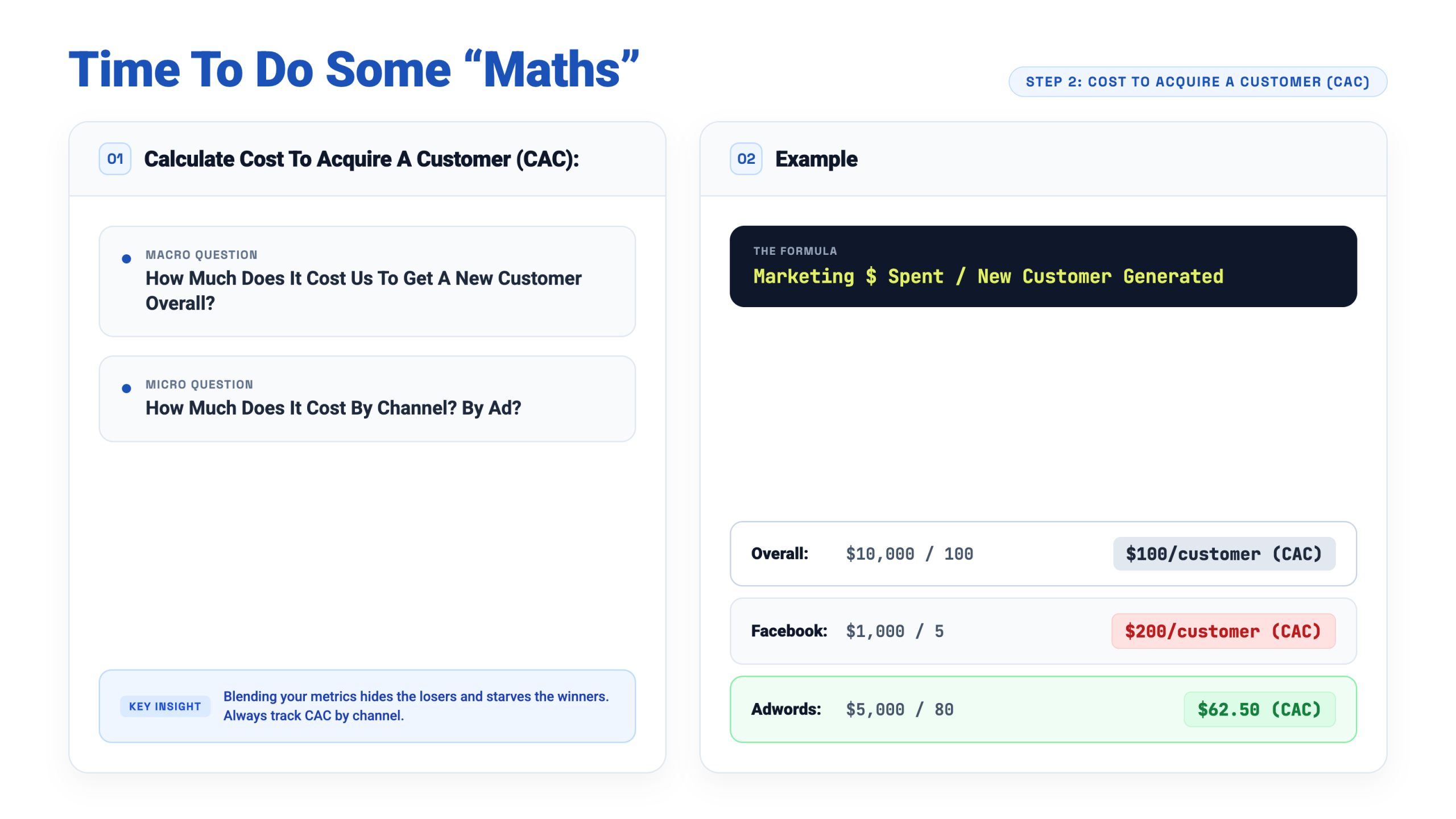
- Middle of Funnel (Chunk 2): Optimize the sequence from the opt-in/tripwire to the core product purchase. Measure customer acquisition cost (CAC).
- Bottom of Funnel (Chunk 3): Optimize the pathway from the active customer into the high-ticket backend upsell. Measure average order value and customer lifetime value (LTV).
6. Digital Advocators Members-Area Tool: The Chunked Funnel Scorecard
To prevent goal dilution and set up clean independent variables in your Google Analytics and CRM dashboards:
- Tool Name: The Chunked Funnel Goal Scorecard
- Purpose: A three-tiered scorecard that isolates top, middle, and bottom of funnel conversion milestones so you can stack-rank winners and eliminate underperforming ads.
- Access: Available inside your Digital Advocators Member Portal.
