The 7 Phases of a Direct-Response Funnel, Offer Stacking, and Environment Architecture
Field notes and direct-response masterclass breakdowns on Session 4: How to filter cold clicks through 7 conversion phases, transform commodities into $50,000 asset stacks, apply the "Fat Marker" origin story rule, and safeguard your enterprise with the protected Black Box.
Most media buyers evaluate marketing through a microscopic lens: an ad headline, a cost-per-click, or a single landing page conversion rate. When campaigns stall, they blame the ad network, tweak targeting parameters, or abandon the channel altogether.
Direct-response veterans operate on a completely different plane. Traffic is merely the raw fuel; the engine is the multi-phase architecture that washes cold strangers through specific psychological filters, captures permanent identity data, extracts buyers immediately, and ascends them through structured relationship environments.
- The Helicopter Pilot Protocol: Why attempting to rescue everyone in the market causes disaster, and why direct-response messaging must focus strictly on those swimming toward the boat.
- The Capacity Expansion Law: Overestimating 12 months vs. underestimating 10 years, and how operational trial and error builds the capacity to handle multi-million dollar scale.
- The Protected "Black Box" Asset: Why ad networks are rented land, the 2:00 AM carpet wax crisis, and why your proprietary database is your company's unkillable equity.
- The 7 Conversion Phases: Deep dive from traffic temperature and the pre-frame bridge to subscriber qualification, buyer separation, hyperactive ascension, and environment shifts.
- The $50,000 Commodity Stacking Shift: How curating high-value assets and direct access transforms a $1,000 commodity into an irreplaceable $50,000 enterprise stack.
- The "Fat Marker" Bonus Origin Story Rule: Why bonuses without origin stories get ignored, and how authentic narratives multiply perceived value tenfold.
- Verbatim 3-Minute & 5-Minute Implementation Work Sessions: Complete audit worksheets for immediate deployment.
1. The Helicopter Pilot Protocol: Rescuing Those Swimming Toward the Boat
Every entrepreneur who begins publishing content or launching paid campaigns experiences an early crisis of confidence: You pour your heart into a 20-minute strategic training, publish it to the world, and receive seventeen views, two likes, and zero comments. The natural human reaction is discouragement: "I wasted my time. The market doesn't care. Nobody is listening."
Direct-response strategy demands that you reframe your metrics through the Helicopter Rescue Protocol:
"When a ship sinks in stormy seas, the helicopter crew cannot save everyone. If they chase swimmers drifting in opposite directions, everyone drowns. In pilot training, the directive is unbending: you deploy rescue lines exclusively to the individuals who are actively swimming toward the craft.
The 37 people who read your post, the 12 who watch your video, and the 3 who leave a thoughtful reply are not numbers on a spreadsheet. They are human beings in acute pain who have recognized your lighthouse and are swimming directly toward your craft.
If you abandon your post because the crowd hasn't arrived, you abandon the individuals who are actively seeking rescue. If you dilute your messaging to entertain cynical spectators who are drifting away, you fail the buyers who are ready to take action right now."
2. The Capacity Expansion Law: Overestimating One Year vs. Underestimating a Decade
Most operators fail because they quit during the "capacity building" phase. We consistently overestimate what we can accomplish in twelve months, and radically underestimate what compounds across ten years.
Consider the reality of multi-million dollar growth:
- Early campaigns often stumble. You may spend six months architecting an acquisition funnel only to net a total return of $47. In the moment, that feels like an hourly wage of pennies.
- However, the operational muscle built during that "failed" launch—mastering scriptwriting, hooking audiences, troubleshooting tracking pixels, and managing merchant gateways—expands your internal capacity.
- If an operator who has never managed $10,000 in monthly ad spend were suddenly handed $500,000 in daily traffic, they would incinerate the cash, break customer fulfillment, trigger credit card chargebacks, and destroy their business.
You must endure the trials of low-volume execution to build the infrastructure capable of handling high-velocity scale.
3. The Protected "Black Box" Asset: Traffic That You Actually Own
Direct-response veterans know that ad networks, search engine algorithms, and social platforms are rented land. At any moment, platform changes or algorithmic purges can wipe out top-of-funnel reach. Your only enduring defense is your Black Box.
"Years ago, before our flagship software existed, our business was crashing. Half of our staff had walked out. We were being evicted from a 20,000-square-foot office lease we could no longer afford.
At 2:00 AM on the night before eviction, my partner and I were on our hands and knees with butter knives, scraping melted candle wax off the basement call center carpet so the landlord wouldn't hit us with penalty damages. We were terrified, exhausted, and down to zero working capital.
In that moment of absolute panic, we asked the only question that mattered: What asset do we still control? We had our customer list—our Black Box. I sat down on an empty box, outlined an advanced direct-response training, and emailed our list inviting them to an exclusive live workshop. Within 48 hours, over 2,500 people registered. On the night we handed the office keys back to the landlord, sitting on an empty packing box with a single laptop, I delivered that presentation.
That single broadcast generated enough capital to cover payroll, secure our new modest workspace, and buy us the runway to engineer our greatest product. When the world falls apart, you cannot sell your desk. You cannot borrow against your Facebook pixel. The only thing that will ever save your enterprise is your direct relationship with the humans in your Black Box."
4. The 7 Phases of a Direct-Response Funnel
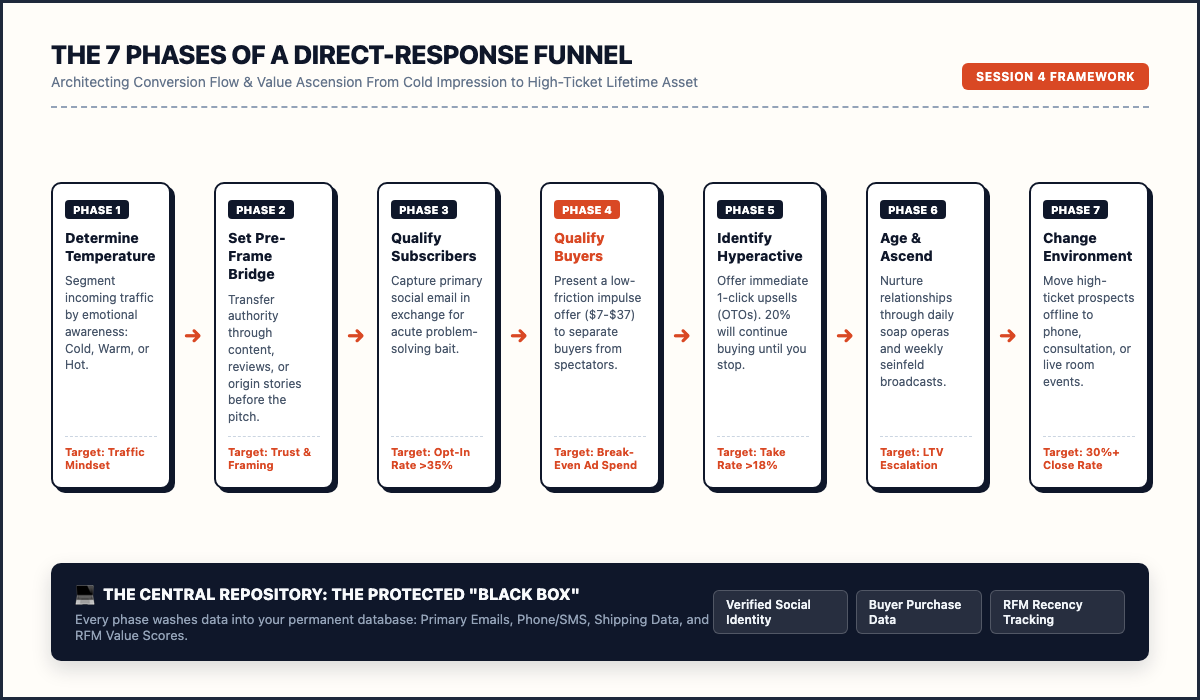
Traffic acquisition is not about driving visitors to a webpage and hoping they buy. It is a systematic, 7-phase filtration engine designed to escalate trust and value at every touchpoint.
Phase 1: Determine Traffic Temperature & Mindset
Before writing a single headline, you must identify where your prospect is entering from. Hot traffic already trusts your attractive character and requires short, assumption-heavy copy. Warm traffic understands the problem and evaluates alternative vehicles. Cold traffic is in acute pain but has zero brand awareness—requiring deep emotional problem identification and extended bridge architecture.
Phase 2: Set the Pre-Frame Bridge
"The way you are introduced to an audience determines your closing percentage far more than what you say on stage." Pre-framing deliberately manipulates expectation before the prospect reaches your pitch. As direct-response pioneer Mark Joyner proved: not all clicks are created equal. A click that arrives after reading a hostile critique arrives skeptical and impossible to convert; that exact same human clicking an authentic, story-based endorsement arrives eager and primed to purchase.
Phase 3: Qualify Subscribers
Never settle for junk, throwaway emails. Use social authentication or acute problem-solving lead magnets that compel prospects to provide their primary communication channel. This event creates a data record in your Black Box, allowing you to deploy automated follow-up sequences regardless of future platform ad policies.
Phase 4: Qualify Buyers
Spectators are not buyers. Free opt-ins prove interest; credit card submissions prove commitment. In Phase 4, present a low-friction impulse offer ($7 to $37). The purpose of the front-end offer is never profit; the purpose is to identify who in your audience is a transactional buyer. When a prospect pulls out their wallet, they cross a psychological Rubicon.
Phase 5: Identify Hyperactive Buyers
Direct-response commerce follows the 20% rule: approximately 20% of your buyers will continue purchasing higher-tier solutions immediately if you give them the opportunity. The moment a customer purchases your front-end offer, present a 1-click One-Time Offer (OTO) that solves the immediate next problem created by their purchase.
Phase 6: Age & Ascend the Relationship
Customer value compounds through time and proximity. Through structured soap-opera sequences, daily storytelling emails, and value-packed broadcasts, you ascend customers from introductory buyers to high-ticket clients.
Phase 7: Change the Selling Environment
To close five-figure consulting engagements, enterprise agency retainers, or high-ticket masterminds, you must change the physical or psychological environment:
- Persuading a prospect while they sit in a cluttered home office with screaming kids and open browser tabs is extraordinarily difficult.
- High-ticket conversion requires shifting the environment: moving to scheduled phone audits, direct-mail dossiers, or intimate live room sessions. When you control the room, closing rates skyrocket from digital benchmarks (1%-3%) to closed-room levels (25%-45%).
5. The $50,000 Commodity Stacking Shift: Transforming the Offer Stack
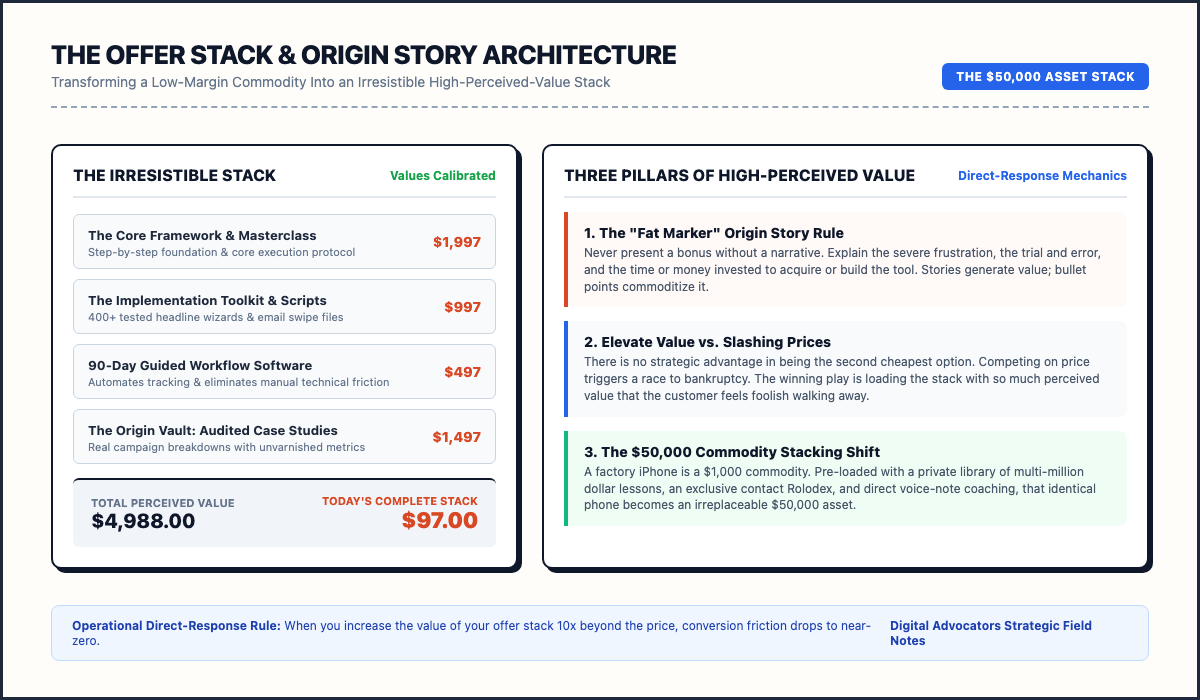
In direct-response marketing, there are only two ways to make an offer seem inexpensive: slash the price (a suicidal race to the bottom) or elevate the offer stack so high that price resistance evaporates.
Consider the $50,000 Smartphone Exercise:
- If you try to sell a standard factory smartphone for $2,000, nobody will buy it. It is an undifferentiated commodity readily available for $1,000.
- Now, imagine that same physical device is pre-loaded with:
- A $650,000 Private Media Library: Every high-level seminar recording, unreleased direct-mail swipe file, and proprietary masterclass from the past fifteen years.
- The Direct Rolodex: Private, verified direct-dial contact numbers for thirty premier industry leaders and direct-response legends.
- Direct Voice Access: A private voice-messaging app connected directly to the mentor, with guaranteed 24-hour turnaround guidance for twelve months.
- To an ambitious operator, that package is worth easily $50,000 to $100,000. Selling it for $5,000 would feel like an absolute steal. The physical medium did not change; the value stack surrounding it transformed the commodity into an irreplaceable asset.
6. The "Fat Marker" Bonus Origin Story Rule
When entrepreneurs construct bonus stacks, they make a fatal error: they list bonuses as sterile bullet points without narrative context. Bullet points commoditize value; origin stories multiply it.
"Every tool in your stack must have a reason for being. When a speaker steps onto a stage and uses a standard skinny pen, it is invisible and unmemorable. But when they pull out an oversized, industrial Magnum Sharpie and share the journey of discovering that Tony Robbins used these exact markers to command the room, the marker ceases to be stationery—it becomes a talisman of authority.
Every bonus you attach to your core offer must answer three questions:
1. What acute frustration forced you to create or acquire this tool?
2. How much time, emotional agony, or capital did you invest to solve it?
3. Why are you gifting this shortcut to the customer today?"
7. Step-by-Step Implementation Work Sessions
Execute these three operational exercises. These are the exact work sessions conducted in Session 4:
| Funnel Phase | Diagnostic Audit Question | Immediate Action Item |
|---|---|---|
| Phase 1: Traffic Temperature | Are ads tailored specifically to Cold vs. Warm mindsets? | Segment campaigns by audience awareness. |
| Phase 2: Pre-Frame Bridge | What content primes visitors before they see the sales pitch? | Deploy a 3-minute bridge video or case study endorsement. |
| Phase 3: Qualify Subscribers | Are you capturing verified primary emails or junk inboxes? | Upgrade lead magnet to solve an acute, urgent problem. |
| Phase 4: Qualify Buyers | Do you have a low-ticket ($7-$37) impulse impulse offer? | Engineer a self-liquidating front-end starter kit. |
| Phase 5: Hyperactive Buyers | Do you present an immediate 1-click upsell after checkout? | Add a $97 speed/automation upgrade on the thank-you flow. |
| Phase 6: Age & Ascend | Do you nurture the database consistently with stories? | Establish daily storytelling Soap Opera / Seinfeld sequences. |
| Phase 7: Change Environment | Are you attempting to close $3k+ deals on digital pages? | Move high-ticket conversions to private telephone strategy sessions. |
Take your core product and engineer a multi-layered asset stack around your dream customer:
- The Core Asset: The foundational training, tool, or product.
- Component 1 (Automation / Software): What tool removes manual friction?
- Component 2 (Execution Framework): What checklist or roadmap guarantees rapid execution?
- Component 3 (Done-For-You Swipe Files): What templates can they copy and paste immediately?
- Component 4 (Structured Office Hours / Audibles): What direct access answers their edge cases?
Draft the origin narrative for your highest-value bonus using this 5-step blueprint:
