The 3 Types of Traffic: Traffic You Control, Traffic You Earn, and the Sovereign Power of Traffic You Own
Field notes and direct-response masterclass breakdowns on media distribution, publishing engines, and sovereign list ownership. How media distribution evolved from 1965 television to smartphone apps, the Arsenio Hall show principle, comedic dive bar testing, turning products into high-ticket offers, and building an owned traffic flywheel.
Media buyers and digital agencies frequently make the catastrophic mistake of measuring business success by temporary vanity metrics: follower counts, video views, or cheap impressions on platforms they do not own. But if your entire audience lives inside an algorithm feed owned by Meta, Google, or ByteDance, you do not own a business. You are a digital sharecropper farming rented land.
The central direct-response thesis of this masterclass is simple and immutable: There are only three types of traffic in the universe: Traffic You Don't Control, Traffic You Control, and Traffic You Own. The single objective of all marketing is to convert every ounce of controlled and uncontrolled attention into sovereign TRAFFIC YOU OWN.
- The Evolution of Media Distribution: 1965 television (ABC, CBS, NBC where Tony Robbins blanketed late-night airwaves) to 10,000 cable networks, and into today's mobile app channels.
- The Arsenio Hall Show Principle: Why nobody returns cold pitch calls, and how launching your own specialized show gives you the platform to infiltrate Influence 100 leaders with zero awkward pitching.
- The 3 Publishing Modalities & Daily Commitment: Writing (Medium), Talking (Podcasting: Marketing in Your Car origin story while facing bankruptcy), and Video (Live streaming). The 365-day commitment that permanently eliminates financial fear.
- Testing Material (The Stand-Up Comedian Protocol): Why elite comedians test raw jokes in local dive bars before filming an HBO/Netflix special, and how to test your hooks daily.
- Product vs. Offer (The P.T. Barnum DVD Masterclass): How to take a $20 commoditized Amazon DVD (The Greatest Showman) and transform it into a $2,000 proprietary offer using public domain literature (Project Gutenberg) and exclusive interview vaults.
- The Storytelling State-Control Engine: Why stories are visceral physical state synchronizations (sweaty palms, racing pulse, lump in throat) that lead prospects to duplicate your breakthrough epiphanies.
- The 3 Types of Traffic Framework: Traffic You Don't Control (earned), Traffic You Control (bought), and Traffic You Own (private subscriber database).
- The Unit Economics of Traffic Ownership: Self-liquidating lead funnels, breakeven front-end ad spend, and zero-marginal-cost email broadcasts delivering 95%+ profit margins.
1. The Evolution of Media Distribution: The 1965 Television Lesson
To understand how modern traffic flows, you must understand distribution history. The instructor shared a foundational analogy originally framed by media entrepreneur Gary Vaynerchuk:
"Think about television in 1965. There were only three television networks in the entire country: ABC, CBS, and NBC. If you turned on the TV at night, everyone in America was watching one of those three channels.
When Tony Robbins built his empire through late-night infomercials in the late 1980s, his strategy was simple: buy airtime across all three networks. You could not turn on a television set after midnight without seeing Tony's face. That is why Tony became one of the most recognizable human beings on earth.
Then cable television arrived, and media splintered across 10,000 niche channels. Tony told me: 'Suddenly, an ad on channel 47 didn't work, channel 112 was too expensive, and the numbers broke down.' The channels multiplied, and attention decentralized.
Look at your smartphone today. Your smartphone is the modern television set. The apps on your home screen: YouTube, Instagram, Facebook, TikTok: are the modern ABC, CBS, and NBC!
Inside each app, people are watching shows. If you do not have your own show broadcast inside those apps, you do not exist in the consciousness of your market."
2. The Arsenio Hall Principle: Why You Must Launch Your Own Show
Entrepreneurs frequently hesitate to start publishing content because they believe their industry is already crowded, or because they feel insecure about having an initial audience of zero.
The instructor cited an iconic entertainment lesson from The Celebrity Apprentice:
"During one season of The Celebrity Apprentice, legendary late-night talk show host Arsenio Hall competed in a charity challenge where contestants had to call wealthy contacts to raise donations. Arsenio struggled. His high-profile Hollywood contacts were not picking up or returning his calls.
Frustrated, Arsenio looked directly at the television camera and uttered one of the most profound truths in business:
'When I had my own show, everyone returned my call.'
When you launch your own specialized podcast, video show, or publication, you create your own platform. Even if you have zero listeners on Day 1, you now possess a legitimate media asset.
When you reach out to a high-status leader on your Influence 100 and say: 'I would love to feature your expertise on my show for 30 minutes,' they say YES! You are not asking them for money or begging for an endorsement. You are giving them a platform to share their story. That single asset opens every closed door in your industry."
3. The 3 Publishing Modalities & The 365-Day Freedom Guarantee
How do you find your unique voice, build an attractive character, and cultivate a responsive following? By committing to the discipline of daily publishing.
The "Marketing in Your Car" Origin Story
"Five years ago, our company suffered a devastating collapse. I had to lay off 80 team members, downsize from a 20,000-square-foot office to a tiny 2,000-square-foot sublease, and stare down massive debt. I was on the brink of bankruptcy.
Most people in that situation would hide. Instead, I decided to document the journey.
I didn't have fancy studio microphones or audio engineers. Every morning, I got into my car to drive to our office. I took out my phone, hit voice memo, set it on the passenger seat, and talked about the raw marketing experiments, mistakes, and lessons of the day. When I arrived at the office, I hit stop and emailed the audio file to my brother to upload.
That podcast was called Marketing in Your Car. In the first 40 episodes, I was awkward, rambling, and unpolished. Nobody was listening! But because I had no idea how many people were listening, I didn't stop.
Somewhere around episode 45, I found my voice. The stories tightened. The frameworks crystallized. Today, people come up to me and say: 'Russell, I listened to you on the treadmill every morning for six months. I felt like I was in the passenger seat with you while you rebuilt your company.'
That deep emotional connection cannot be purchased with banner ads. It is earned through consistent, vulnerable publishing."
"I make this solemn promise to you: if you pick one modality (writing, audio, or video) and commit to publishing every single day for 365 consecutive days, by the end of that year, all of your financial worries will be permanently eliminated."
4. Testing Material: The Stand-Up Comedian Dive Bar Protocol
Why should you publish daily even when your audience is small? Because publishing is your private direct-response rehearsal stage:
"Consider how elite stand-up comedians like Jerry Seinfeld or Dave Chappelle build a world-class comedy special.
They do not write jokes in a vacuum and immediately walk onto a stadium stage with 20,000 people and cameras rolling! If they did that, they would bomb and ruin their career.
Instead, they go down to a tiny, dimly lit comedy cellar or local dive bar on a Tuesday night. They pull a crumpled napkin from their pocket with ten raw joke ideas. They tell the jokes in front of 30 people.
Seven jokes bomb in complete silence. Two get polite chuckles. One joke makes the entire room roar with laughter!
The comedian crosses out the seven failures, polishes the winner, writes nine new jokes, and returns the next night. They repeat that testing process for twelve straight months. By the time they film their Netflix special, every single word, pause, and punchline has been battle-tested on live audiences hundreds of times.
That is exactly how you must treat your daily content! Your podcast episodes, blog posts, and live streams are your dive bar sets. You test hooks, stories, and frameworks. When an angle flops, nobody notices because your audience is small. But when an angle catches fire and comments explode, you know you have struck gold. You take that winning hook and turn it into your next paid ad campaign, webinar, or front-end book!"
5. Product vs. Offer: The P.T. Barnum DVD Masterclass
The single greatest point of failure in digital products and consulting is selling a product rather than an offer. A product is a commodity; an offer is an irresistible bundle that can only be purchased from you:
"Let's take a common DVD of the musical film The Greatest Showman. If I try to sell that DVD on Amazon, what is it worth? It is a commodity worth $19.99. If I sell it for $20 and a competitor sells it for $18, I lose the sale. You cannot build a scalable business competing on commodity pricing.
Now, how do we transform that $20 DVD into an irresistible, proprietary offer for entrepreneurs that sells for $1,000 or $2,000?
Watch how we build the offer stack:
1. The Core Physical Asset: The Greatest Showman DVD ($20 value).
2. Public Domain Literature (Project Gutenberg): P.T. Barnum died over a century ago, meaning all of his original books are in the public domain at gutenberg.org. I download three of Barnum's original manuscripts on entrepreneurship, hire a designer to create custom leather-bound digital covers, and write a modern executive introduction. Now you receive the P.T. Barnum Lost Entrepreneurship Trilogy.
3. The Curated Video Vault: I spend an afternoon on YouTube researching historical documentaries and expert analyses on P.T. Barnum's marketing genius. I organize the best 10 videos into a private member portal called The Barnum Marketing Archive.
4. Expert Audio Interviews: I search podcast directories and locate the top historians and biographers who have studied Barnum's promotional tactics. I reach out to them and conduct exclusive 30-minute interviews, packaging them into an audio series called Barnum's Pillars of Spectacle.
5. The Unreleased Manuscript: I contact my friend Joe Vitale (author of There's a Customer Born Every Minute). Joe reveals he wrote an unreleased 30-page manuscript titled The 10 Rings of Power. I license the rights to include that manuscript in my bundle.
Now, examine what we are selling:
You don't just get a $20 DVD. You get the DVD, plus the 3 lost Barnum books, the curated video vault, the exclusive expert interview series, and Joe Vitale's unreleased manuscript!
Can you buy that bundle on Amazon? No! Can you find it at Walmart? No! It is no longer a commodity; it is a proprietary OFFER. I can charge $500, $1,000, or $2,000 for that bundle because I am the only human being on earth who sells it, and its perceived value is immense."
6. The Storytelling State-Control Engine: Epiphany Bridges & Physical Emotion
Why do direct-response campaigns rely so heavily on long-form storytelling? Because human beings make purchasing decisions based on emotional states, not intellectual bullet points.
"Most amateur marketers tell stories like this: 'I was tired, then I worked really hard, and then I went home.' That does not create empathy; it creates boredom.
When you tell a story, your goal is State Control. You want the prospect's nervous system to experience the exact physical sensations you felt when you were struggling, so that when you reveal your breakthrough, they experience the identical epiphany!
Don't just say you were stressed. Describe what was happening to your body:
'My lower back was burning with sharp, stiff pain from sitting hunched over on the carpeted floor for eight hours doodling marketing diagrams.'
'My palms were cold and drenched in sweat as I dialed my banker's number, terrified that our payroll check was going to bounce.'
'My neck felt like it was in a chokehold as my shirt collar tightened during church service.'
When you describe visceral physical sensations, mirror neurons fire in your prospect's brain. Their neck tightens, their heart rate elevates, and their palms get clammy. You have brought them into your emotional state. When you share the epiphany that set you free, they receive it not as a sales pitch, but as their own realization."
7. The 3 Types of Traffic: Control, Don't Control, and Own
Every visitor who touches your business belongs to one of three categories:
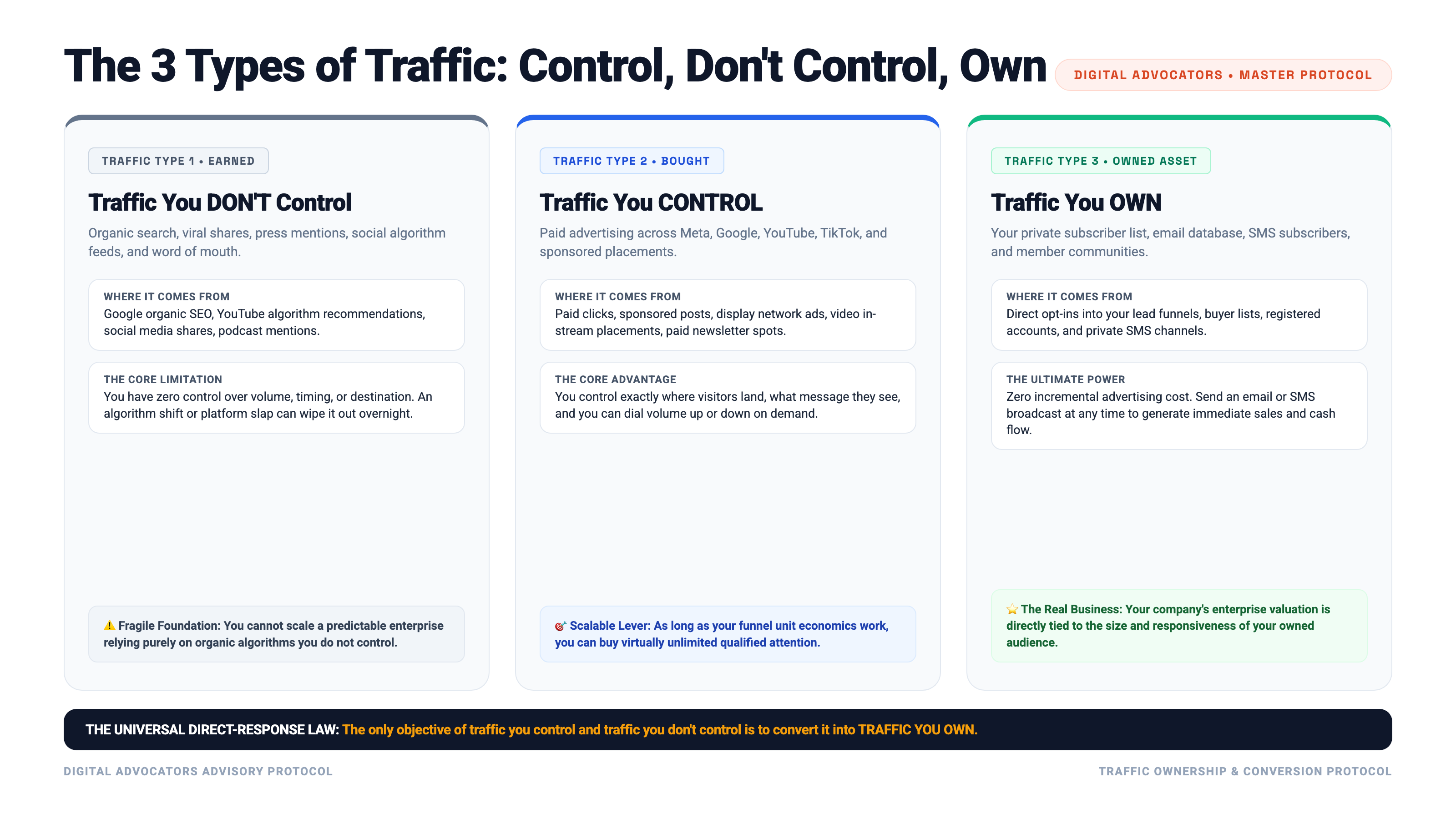
- Type 1: Traffic You DON'T Control (Earned Traffic): Organic search, viral social shares, podcast guest spots, PR articles, and algorithm recommendations. Free upfront, but fragile: you have zero control over volume, and platform shifts can wipe it out overnight.
- Type 2: Traffic You CONTROL (Bought Traffic): Paid media on Meta Ads Manager, Google Search, YouTube Ads, LinkedIn, and sponsored newsletters. You control the landing page, headline, targeting, and volume, but it stops the second you pause ad spend.
- Type 3: Traffic You OWN (The Sovereign Asset): Your private database: email subscribers, SMS broadcast lists, active community members, and existing buyers. You can broadcast at any hour for $0 incremental ad cost, generating immediate revenue on demand.
"The only objective of traffic you control and traffic you don't control is to convert it into TRAFFIC YOU OWN."
8. The Ultimate Traffic Ownership Flywheel & Unit Economics
How do high-growth direct-response companies scale to eight and nine figures while competitors go bankrupt on ad costs? By building a self-liquidating traffic flywheel:
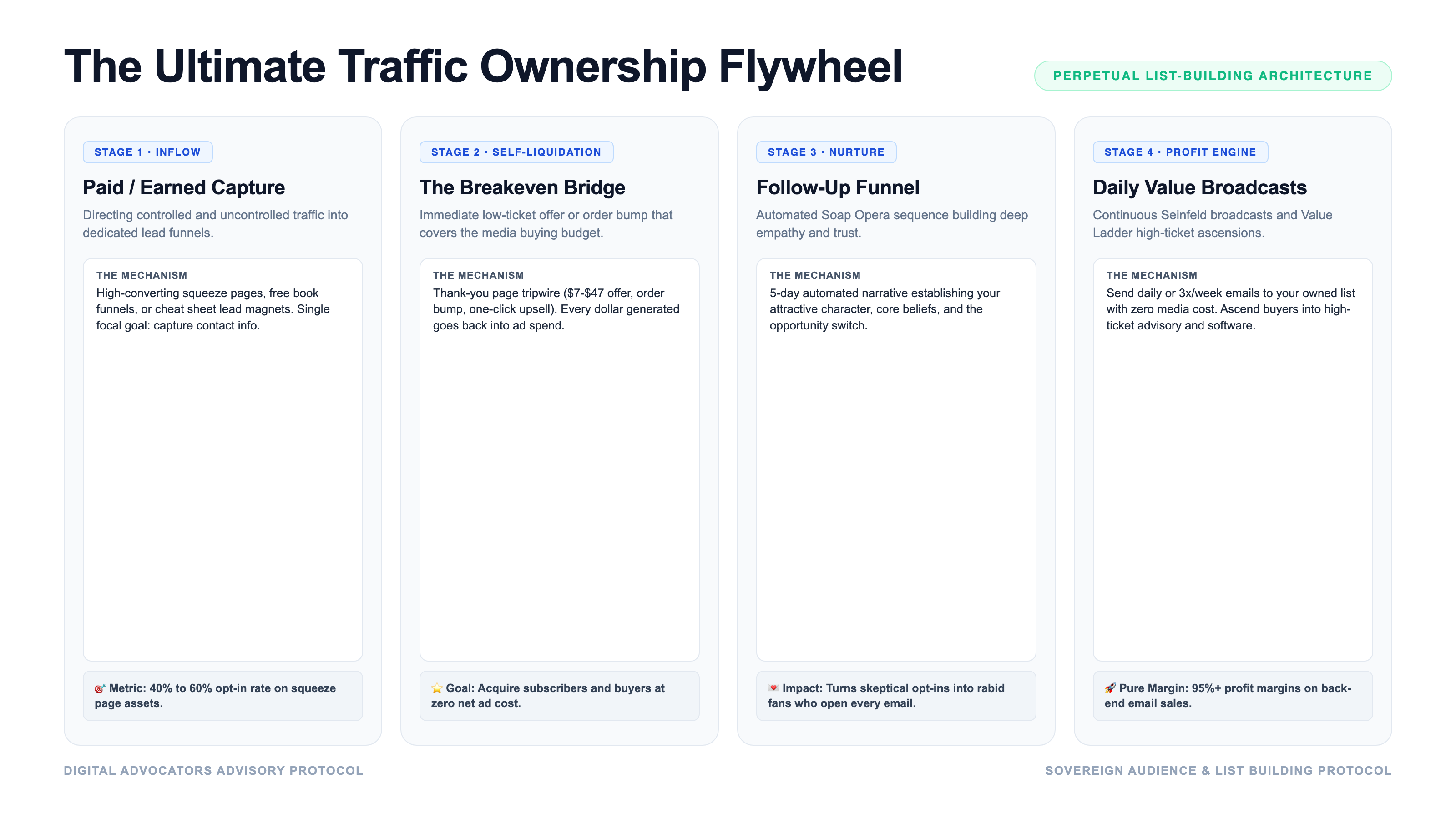
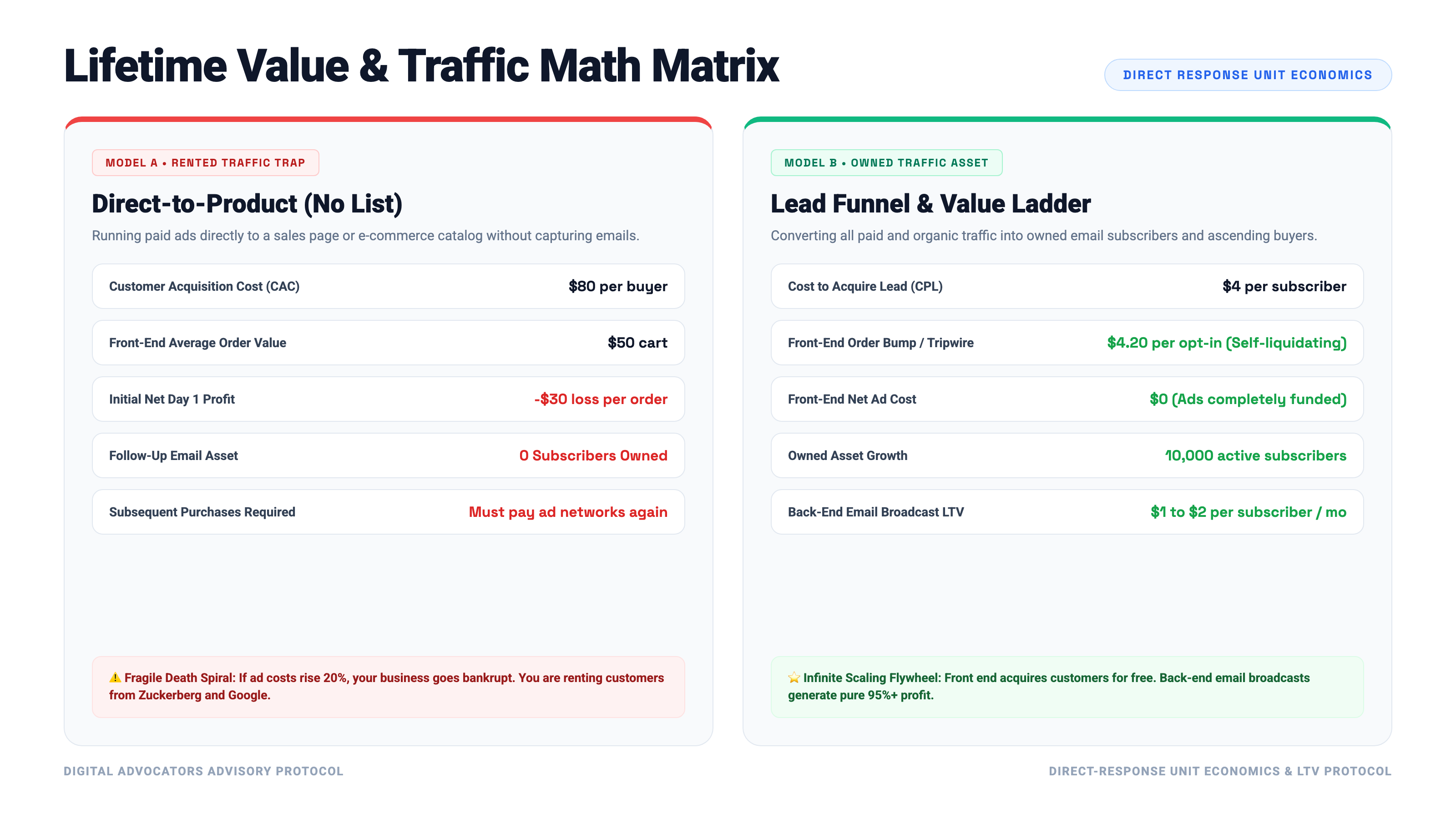
| Economic Metric | Model A: Rented Traffic Trap (Direct-to-Product) | Model B: Owned Traffic Flywheel (Lead Funnel + List) |
|---|---|---|
| Traffic Destination | Direct e-commerce product page or sales catalog. | High-converting 2-page lead squeeze funnel. |
| Opt-In Conversion Rate | 0% (No lead capture mechanism). | 45% to 55% opt-in rate on squeeze page. |
| Front-End Cost to Acquire | $80 ad spend per paying buyer. | $4 ad spend per email subscriber ($40 per buyer). |
| Front-End Liquidation | $50 cart value (Net Day 1 Loss: -$30 per buyer). | $7 tripwire + $27 order bump (Breakeven: $0 net ad cost). |
| Long-Term Database Built | 0 owned email subscribers. | 10,000 to 50,000 verified email subscribers. |
| Back-End Broadcast Revenue | $0 (Must repay ad networks to reach past customers). | $1.00 to $2.00 per subscriber per month (Pure Profit). |
| Strategic Advantage | Fragile. Crushed by rising ad costs. | Infinite scale. Can outspend all competitors. |
9. Sourcing "Sawdust" Content: The 52-Week Production Grid
How do you maintain daily or weekly publishing without burning out? By understanding the concept of sawdust:
"In a lumber mill, the primary product is dimensional lumber. But as they cut the wood, tons of sawdust fall to the floor. Smart lumber mills don't sweep the sawdust into the trash; they collect it, compress it into particle board or fire logs, and sell it for millions in additional revenue!
Your weekly core show is your dimensional lumber. Everything else is sawdust!
Here is how you map an entire year of content in 60 minutes:
1. Take a sheet of paper and write down the 12 core subtopics of your industry (copy, funnels, traffic, design, offer creation, tracking, video, email, follow-up, pricing, psychology, team).
2. Under each of the 12 core topics, write down 4 specific, granular sub-angles (under Design: ad creative styles, landing page layouts, typography rules, mockups).
3. 12 topics multiplied by 4 angles equals 48 specific weekly show topics! That is an entire year of long-form shows.
4. Record your weekly long-form show (podcast or video).
5. Collect the 'sawdust': have a virtual assistant extract 3 short video clips, 2 text quotes, and 1 actionable checklist from that single recording.
6. Post the sawdust across Instagram, LinkedIn, Facebook, and Twitter to drive traffic back to your owned show!"
10. Step-by-Step Implementation Roadmap
To execute the teachings of Session 3 so you never have to rewatch the video, execute this operational sequence:
- Step 1: Select Your Sovereign Show Modality: Choose Writing (Blog/Medium), Talking (Podcast), or Video (YouTube/Live Stream). Name your show around your market's core journey. Commit to publishing on your chosen schedule for the next 365 days.
- Step 2: Build Your 52-Week Content Grid: Write down your 12 pillar topics. Add 4 specific operational sub-angles under each pillar. Block out two hours every Monday or Friday to batch record your upcoming episodes.
- Step 3: Implement the Lead Squeeze Gateway: Audit all of your existing traffic channels (social profiles, blog headers, podcast show notes, guest appearances). Ensure every link points directly to a dedicated 2-page lead squeeze funnel with an irresistible ethical bribe.
- Step 4: Engineer Your Offer Stack: Take your core product or service and bundle 5 complementary assets around it: public domain frameworks, proprietary templates, expert audio interviews, and risk reversal guarantees. Stack the components into an irresistible offer that breaks free from commoditization.
