Post 52: Pillar #12: Google Traffic Growth Mastery
How direct marketers harness high-intent search traffic, conquer the Skyscraper standard, and rent Page 1 virtual real estate without waiting 12 months for SEO.
In Pillar #10 and Pillar #11, we examined how to extract traffic from the social media giants—Instagram and Facebook. Both platforms operate on Interruption Traffic: your prospect is lounging on the couch, catching up with friends, or scrolling through memes when your hook suddenly interrupts their pattern.
Now, we enter an entirely different psychological universe: Google.
"On social networks, you are interrupting someone's leisure time. On Google, the user is in an active problem-solving state. They have a burning question, a broken pipeline, or an urgent desire, and they are actively typing the words into a search box looking for relief. Search traffic represents the highest commercial intent on the internet."
When you master Google, you don't chase traffic. You position your funnels at the exact digital crossroads where qualified buyers are already searching with their credit cards in hand.
In this masterclass breakdown of Pillar #12, we trace the Four Evolutionary Phases of Google, unpack the Skyscraper Content Framework to dominate organic search, and reveal the direct-response growth hack of Renting Virtual Real Estate to capture Page 1 rankings overnight without waiting 12 months for SEO algorithms.
1. The 4 Evolutionary Phases of Google: The Battle for the Top
To understand how to rank on Google today, you must understand the historical battle between Google's engineers and direct-response marketers.
Google’s business model depends on showing searchers the single most relevant, authoritative answer on the internet. Marketers want their own pages at the top of the search results. This eternal tension led to four distinct evolutionary phases:
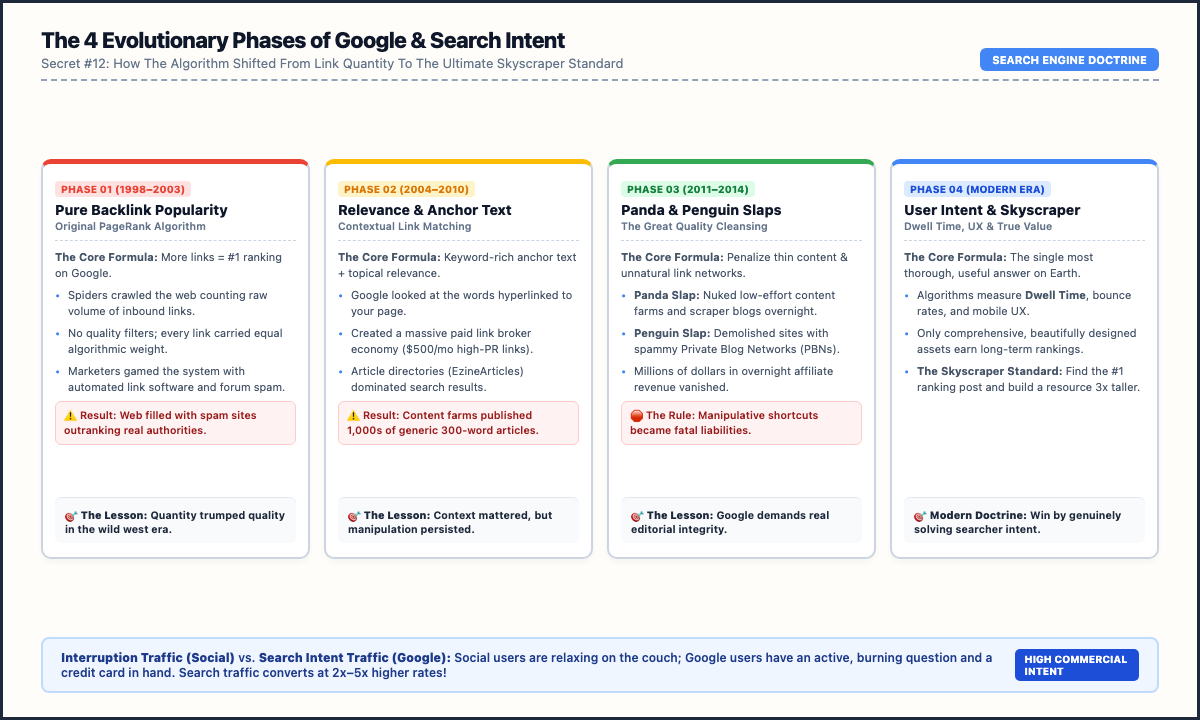
Phase 1: Pure Backlink Popularity (1998–2003)
In the early days of the web, search engines like Yahoo and AltaVista ranked sites based on keyword frequency in meta tags. Google revolutionized search with the PageRank algorithm: it treated backlinks as "votes" of confidence. In this wild-west era, raw link volume reigned supreme. Marketers used automated software to blast links across millions of forums and guestbooks to grab #1 rankings.
Phase 2: Anchor Text and Directories (2004–2010)
Google refined its spiders to inspect the anchor text of inbound links and the topical relevance of linking domains. Marketers adapted by launching massive networks of article directories (e.g., EzineArticles) and buying expensive links from high-ranking sites. The web became bloated with shallow, generic 300-word articles written exclusively for search bots rather than human readers.
Phase 3: The Great Slaps—Panda & Penguin (2011–2014)
Google struck back with catastrophic algorithmic penalties:
- The Panda Slap (2011): Decimated websites with thin, duplicated, or low-quality content. Content farms and scraper blogs were wiped from search indexes overnight.
- The Penguin Slap (2012): Penalized sites with manipulative backlink schemes, unnatural keyword-stuffed anchor text, and Private Blog Networks (PBNs). Millions of dollars in automated affiliate revenue evaporated in 48 hours.
Phase 4: User Intent and The Skyscraper Standard (Modern Era)
Today, Google measures real user engagement signals: Dwell Time (how long a user stays on your page before clicking back), bounce rate, click-through rate, and mobile responsiveness. If a searcher lands on your page, spends 7 minutes reading your frameworks, and never clicks back to Google, the algorithm recognizes your asset as the definitive answer.
2. Seed Keywords vs. Long-Tail Search Intent
Amateur marketers make the mistake of targeting broad, single-word Seed Keywords (e.g., "marketing" or "fitness"). These keywords are brutally competitive, exorbitantly expensive to bid on, and attract unfocused, low-converting browsers.
Direct-response practitioners focus on Long-Tail Intent Phrases:
3. Strategy A: The Skyscraper Method (Work Your Way In)
When building organic search traffic, direct-response marketers follow the Skyscraper Technique:
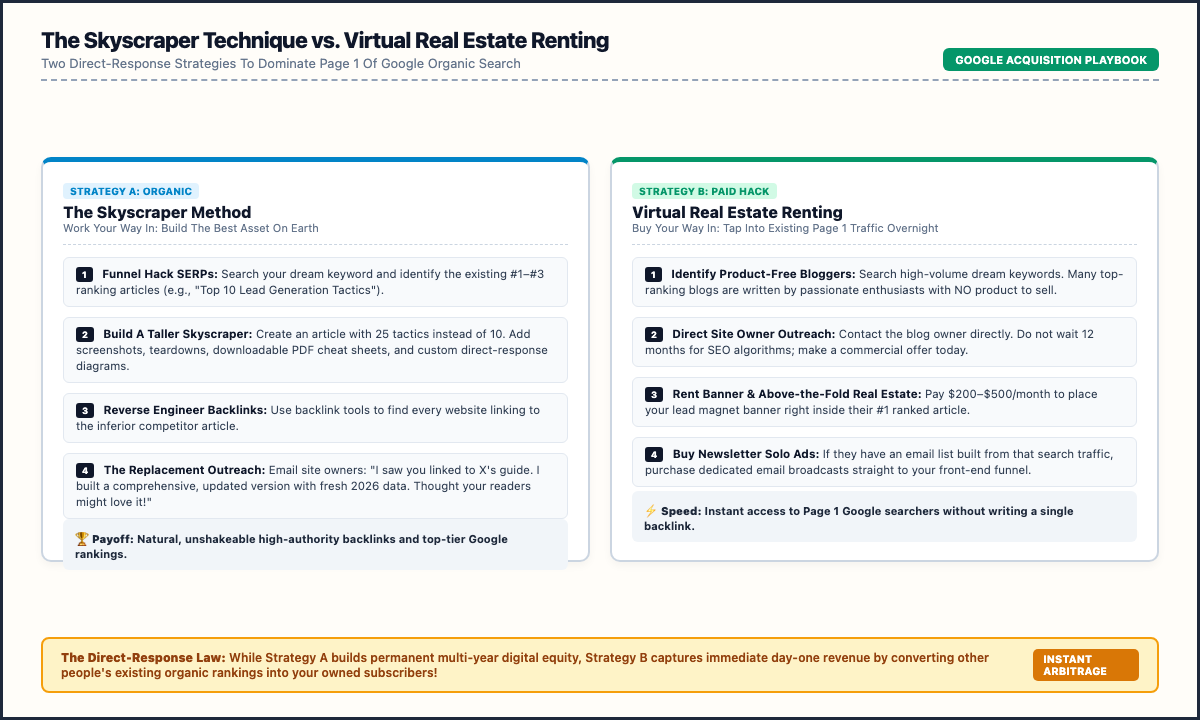
4. Strategy B: Renting Virtual Real Estate (Buy Your Way In)
Organic SEO takes months of disciplined execution. What if you need qualified, high-intent Google search traffic today? You deploy the ultimate direct-response growth hack: Renting Virtual Real Estate.
The Hobbyist Blogger Arbitrage
Many of the blogs and content sites ranking #1 to #5 on Google for lucrative search keywords are owned by hobbyists, content writers, or enthusiast bloggers. They know how to write articles and rank on Google, but they have zero business acumen and no proprietary products to sell.
They make a meager $30 a month displaying ugly, low-paying AdSense banners on pages that receive 15,000 targeted search visitors every month. Direct-response operators do not compete with these bloggers—they partner with them directly by offering guaranteed monthly sponsorship fees ($200 to $500/month) to place banners and capture that Page 1 search traffic immediately.
5. Action Work Sessions
Commit the next 18 minutes to engineering your search traffic asset strategy.
Map 1 broad seed keyword into 5 specific long-tail buyer questions:
- Core Seed: [e.g., Lead Generation]
- Query 1: "How to calculate customer acquisition cost in SaaS"
- Query 2: "Self liquidating offer teardown examples"
- Query 3: "Why did my Facebook ad account get disabled"
- Query 4: "High ticket sales funnel template for agencies"
- Query 5: "How to retarget non-buyers with email follow up funnels"
Audit the #1 ranking competitor post and outline 3 upgrades to make your post 3x taller:
2. Visual Blueprints: Add 2 clean direct-response architectural diagrams.
3. Action Asset: Attach an executable 1-page PDF checklist and unit economics calculator.
Identify 3 ranking blogs and prepare your direct sponsorship outreach:
- Target 1: Top-ranking niche blog URL • Site owner name.
- Target 2: Secondary review site • Monthly traffic estimate.
- Outreach Draft: "Would you be open to a guaranteed $300/mo sponsorship to place our free lead magnet banner above the fold on your [Article Title] page?"
6. Master Implementation Checklist
- Target Intent Over Volume: Abandon generic broad keywords; focus exclusively on long-tail, high-intent problem phrases.
- Mine Google Autocomplete & Related Searches: Systematically gather real user questions to form the sub-headings of your articles.
- Execute the Skyscraper Method: Locate the #1 ranking competitor post and build a resource that is 3x more thorough, actionable, and visual.
- Reverse Engineer Competitor Links: Catalog every site linking to the inferior post and reach out offering your superior resource.
- Rent Virtual Real Estate: Find Page 1 blogs owned by hobbyists and buy their banner space and newsletter solo ads directly.
- Deploy Paid Search for Speed: Bid on high-intent transactional search phrases to capture instant qualified traffic into your front-end funnels.
- Set Up Google Display Retargeting: Retarget non-converting search visitors across YouTube and the Google Display Network.
