Pillar #1: Who Is Your Dream Customer? The Avatar Room, 3 Core Desires, and Search vs. Interruption Mindsets
Why product obsession leads to extinction, how to build an avatar-centric decision engine, and the Robert Collier rule of entering the customer's internal dialogue.
Most entrepreneurs mistakenly assume that their business is about them, their credentials, or their product features. The primary law of traffic generation is uncompromising: Your business is not about you. It is entirely about your dream customer.
Companies obsessed with products fail when superior distribution emerges; companies obsessed with their dream customer build enduring category sovereignty. By filtering every decision through the "Alexis" Avatar Protocol, targeting exactly one of the 3 Core Desires at a time, and understanding the polar forces of Away-from-Pain vs. Toward-Pleasure, you create irresistible front-end gravity.
1. The "Avatar Room": Running a Customer-Centric Enterprise
Consider the revealing case study of a major beauty supply retailer. When an outside direct-response developer presented three new product concepts to executive leadership, each was systematically rejected with the phrase: "Alexis wouldn't like this."
Frustrated, the developer demanded to know if Alexis was the CEO or senior buyer. In response, the executives escorted him into a dedicated conference room whose walls were lined with photographs, psychological profiles, and demographic records of "Alexis"—their fictitious dream customer avatar.
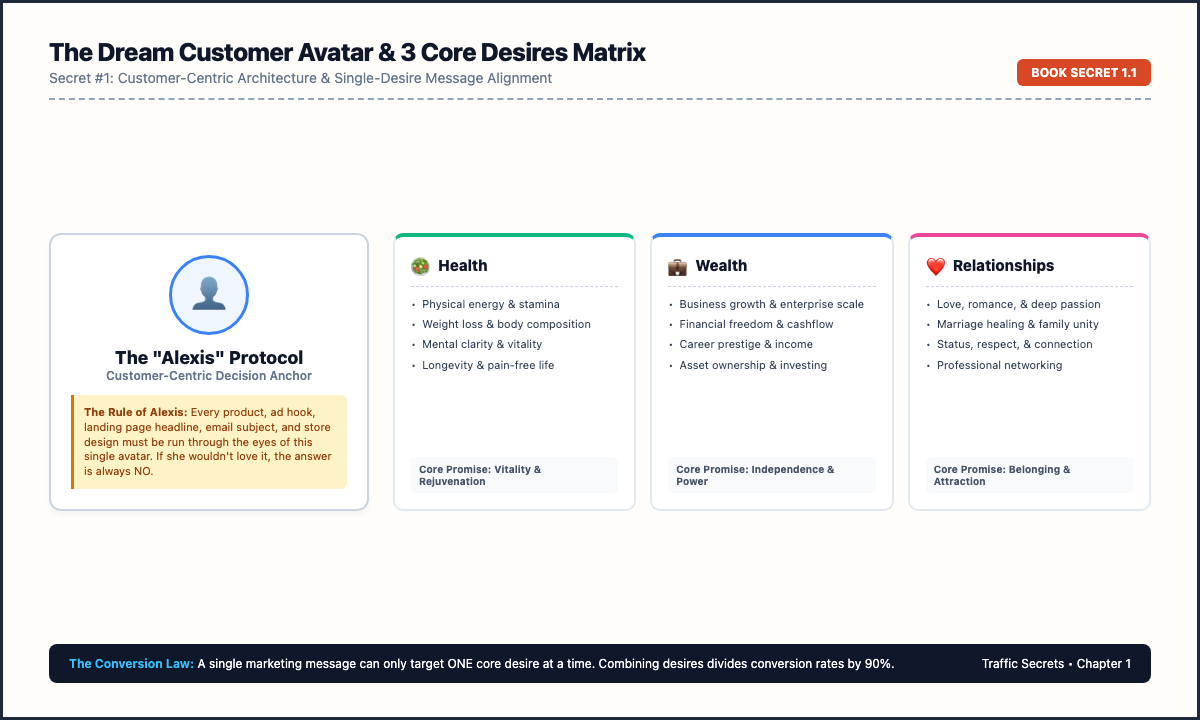
Every store layout, product purchase order, packaging color, headline test, and background soundtrack was judged through Alexis’s eyes. If she would love it, the answer was yes; if not, the answer was always no. They operated a customer-centric enterprise, not a product-centric one.
2. Your Mess Becomes Your Message
To truly understand your dream customer, you must remember the emotional reality of your own past struggles. Most high-performing direct-response companies are born when a founder encounters a painful bottleneck, finds existing market solutions inadequate, and is forced to engineer their own breakthrough. Their mess became their message.
- Channel Hard-Won Empathy: When you recall the exact sleepless nights, anxiety, and frustration you felt before discovering your solution, your copywriting ceases to sound like generic corporate marketing.
- Product of the Product: When your personal transformation or firm's case study visibly embodies the transformation your avatar desires, buyer skepticism dissolves.
- Entering The Mind's Conversation: As Robert Collier famously declared in 1937: "Always enter the conversation already taking place in the customer's mind."
3. The 3 Core Desires & The Single-Desire Conversion Rule
All human commerce flows through three primary desire oceans: Health, Wealth, and Relationships. When a consumer buys any product, they seek a result in one of these three domains.
Vitality, physical energy, weight loss, mobility, nutrition, mental clarity, and longevity.
Financial independence, business scale, career prestige, cashflow, and investing growth.
Love, marital intimacy, romance, family harmony, status, and professional belonging.
4. Away From Pain vs. Toward Pleasure
Human beings are motivated by two distinct directional vectors: escaping immediate discomfort (Away From Pain) or expanding toward aspirational status (Toward Pleasure).
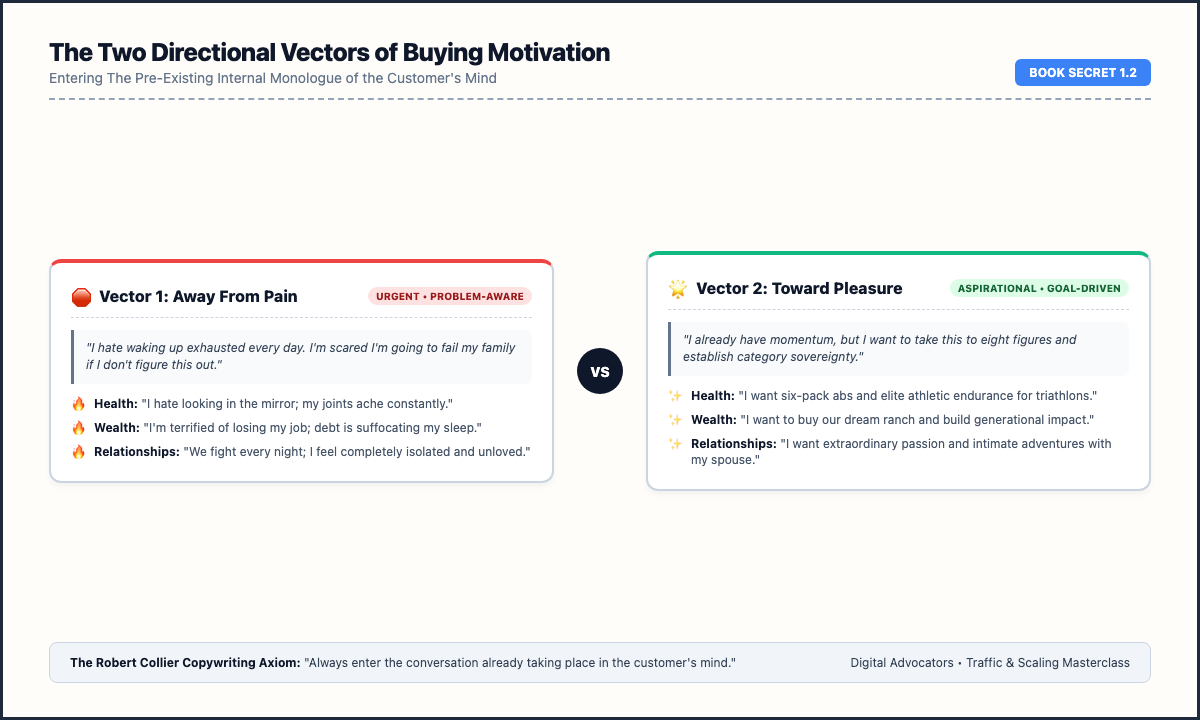
Two customers may purchase the exact same consulting program or software tool for polar opposite reasons:
- The Pain-Avoidant Buyer: "I hate my job, I'm scared my business is bleeding cash, and I can't sleep from panic."
- The Pleasure-Seeking Buyer: "I already have a profitable operation, but I want to scale to eight figures and dominate the category."
Master copywriters catalog both internal monologues to deploy targeted hooks that address both halves of their addressable market.
5. The Searcher vs. The Scroller: Intent vs. Interruption
Online traffic operates under two distinct psychological modes:
- The Searcher (High-Intent / Search Traffic): Originating from the Yellow Pages, Google, and YouTube search. The buyer is problem-aware and actively seeking a solution. The pro is high purchase readiness; the con is intense price competition and feature comparison.
- The Scroller (Interruption Traffic): Originating from the 1941 TV commercial and perfected by modern social feeds. The user is browsing for entertainment, and your ad interrupts their trance. The pro is massive scale and the ability to manufacture desire on demand without price commoditization; the con is that you must master Hook, Story, and Offer to capture and hold their attention.
6. Verbatim Work Sessions & Action Exercises
Define your primary dream customer avatar profile:
Brainstorm the verbatim internal dialogue running inside your avatar's mind:
2. "I'm terrified that..."
3. "Why does it always stall when..."
4. "I'm exhausted from..."
2. "My dream milestone is..."
3. "I want the freedom to..."
4. "Imagine how it will feel when..."
Map your customer acquisition angles across both search intent and social interruption:
