Search vs. Interruption: Matching Traffic Mindsets, Dan Kennedy's Pricing Law, and Desire-Based Selling
Field notes and direct-response masterclass breakdowns on search intent, pattern interrupts, and premium pricing. How to navigate the 200-year evolution of advertising, escape the search price trap, command premium pricing, and architect converting hook-story-offer campaigns.
The vast majority of paid ad campaigns collapse because the media buyer treats all traffic as if it possesses the identical mental state. They take an ad strategy that worked on Google Search and try to run it on Facebook Newsfeeds, or they take a long-form emotional story designed for Instagram and send it to high-intent Google searchers. Both campaigns fail catastrophically.
To generate massive, scalable revenue with paid media, you must master the two fundamental traffic mindsets: Search Traffic (buying based on immediate need and conscious intent) and Interruption Traffic (buying based on desire, curiosity, and high perceived value). This masterclass reveals how commercial advertising evolved from 1835 to the modern algorithm era, how to avoid the deadly "price race to the bottom," and how to architect ad funnels that match the prospect's exact psychological state.
- The 200-Year Evolution of Advertising: From 1886 Yellow Pages (search) to 1835 direct mail, 1922 Hawthorne Court radio commercials, and the 1927 invention of television in Idaho.
- Search Traffic (Needs-Based Commerce): High intent and hot buyers, but the fatal danger of the comparison shopping price trap (why Amazon and Google drive margins to zero).
- Interruption Traffic (Desire-Based Commerce): Capturing passive social scrollers, building desire from scratch, and selling at 10x to 100x higher price points.
- The Trevor Chapman Case Study: A $90 Amazon search DIY alarm box vs. an interrupted dinner door-to-door presentation closing a $1,000+ security contract.
- Dan Kennedy's Premium Pricing Law: Why there is zero strategic advantage in being the second-lowest price leader, and why being the most expensive creates a massive commercial moat.
- The Interruption Engine (Hook, Story, and Offer): Pattern interrupts in 0-3 seconds, Epiphany Bridge storytelling, and stacked value propositions.
- Congregation Discovery: Sourcing authentic customer language (the copywriter who sat in a hair salon) and locating where prospects hang out when not searching for you (TheMat.com).
1. The 200-Year Evolution of Advertising: From Need to Desire
To understand where paid digital media is headed, you must understand where human commerce originated. Most contemporary media buyers believe advertising started with Google and Facebook. Direct-response marketers study the deep history of human interaction:
"I want you guys to put yourself back in time: back when things were black and white on TV, and even before that. Think about human beings and how customers purchased goods.
Before television, before radio, before the internet, how did someone buy something? You sat in your living room. You realized your toaster was broken. You turned the key in your car, drove into town to the general store, walked over to the shelf, saw five toasters, grabbed the cheapest one, paid the clerk, and drove home. People bought things strictly based on what they NEEDED.
In 1886, the Yellow Pages directory was invented. It was pure search. Your toilet flooded, you opened the Yellow Pages, looked under 'Plumber,' found the nearest or cheapest guy, and gave him a call. You had a need, you searched for it, and you transacted.
But direct-response pioneers realized that human desires are infinitely larger than human needs. The very first interruption direct marketing in history happened in 1835. The American Anti-Slavery Association sent out direct mail tracts. People were expecting letters from their friends, and suddenly this printed tract was delivered to their mailbox. People were shocked. It was the very first piece of direct mail that interrupted daily life.
In 1922, radio was completely free. Broadcasters wondered: 'How are we supposed to make money with this?' An apartment complex called Hawthorne Court in Jackson Heights, New York, bought the very first radio commercial saying: 'We have vacancies, come check it out.' People were listening to music or an audio drama, and suddenly they were interrupted with a commercial proposition.
In 1927, television was invented by Philo Farnsworth in Idaho. You were watching a program, and suddenly: 'Buy this watch!' Interruption marketing officially arrived."
2. Search vs. Interruption: The Two Fundamental Mindsets
Every visitor arriving at your website or ad campaign is in one of two distinct psychological states: Search Mode or Interruption Mode.
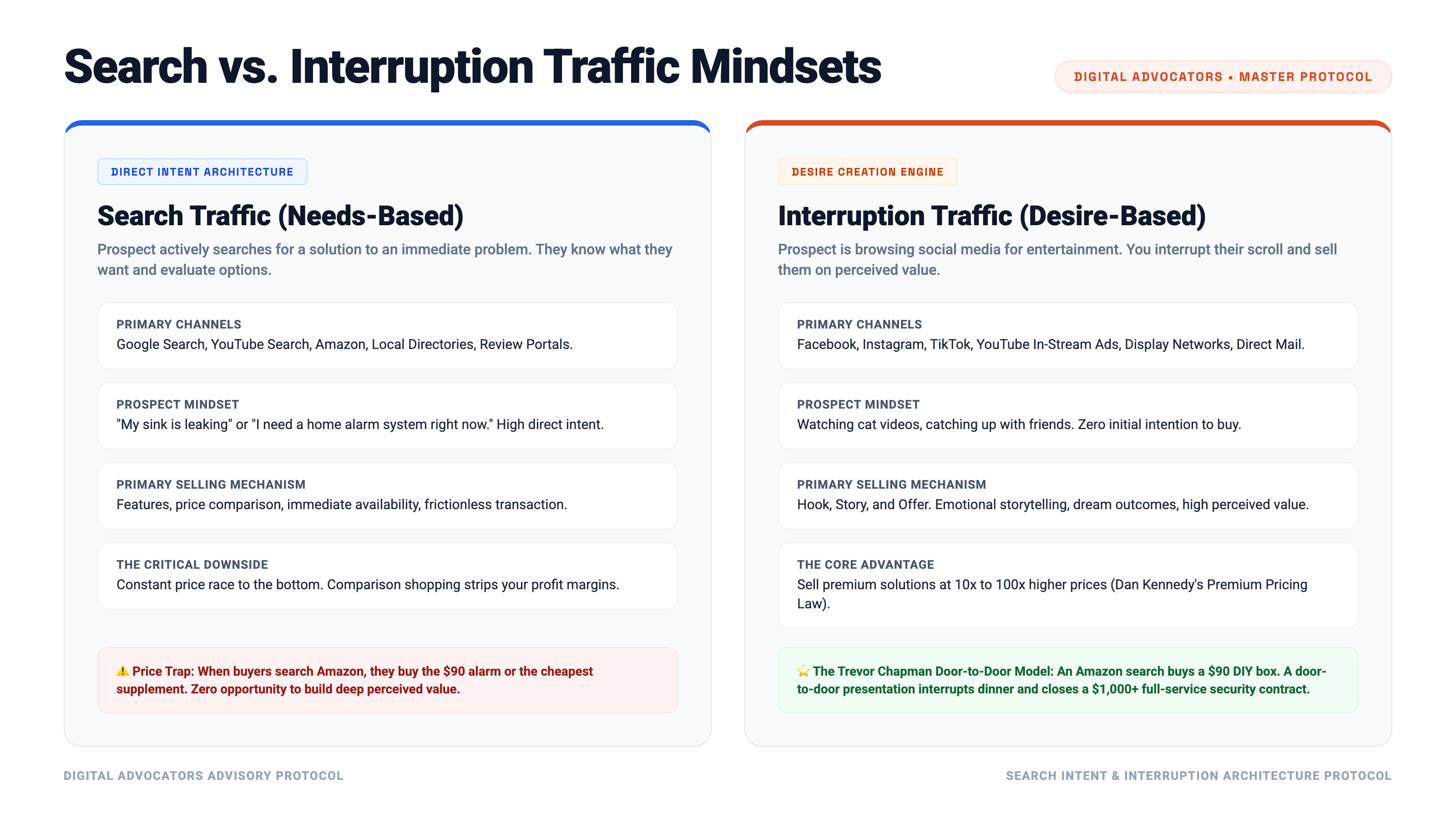
The Pros and Cons of Search Traffic (Needs-Based)
When someone goes to Google, YouTube Search, or Amazon and types a query, they are hot traffic. They have a conscious problem and are actively looking for a solution.
- The Core Advantage: Extremely high immediate intent. If someone searches "emergency plumber Boise" or "buy sales funnel software," they are ready to transact today.
- The Fatal Trap (The Price Race to the Bottom): Because the prospect is actively searching across a directory or search engine, they can see 20 of your competitors on the exact same screen! You have zero opportunity to present a long-form emotional story. The buyer instinctively compares specs, reviews, and prices, picking the cheapest option. You become a commoditized price-taker.
The Pros and Cons of Interruption Traffic (Desire-Based)
Interruption traffic occurs on platforms like Facebook, Instagram, TikTok, YouTube In-Stream ads, and direct mail. The prospect is NOT looking for you.
- The Core Advantage: You can sell on perceived value rather than price comparison. Because you plucked the prospect out of their environment into your private funnel, there are zero competitors on your page. You can charge 10x to 100x more than retail commoditized prices.
- The Operational Requirement: You cannot run lazy, direct product ads. You must become a master of Hook, Story, and Offer. You must stop their mindless scrolling, capture their attention, and create desire from scratch.
3. The Trevor Chapman Case Study: A $90 Amazon Search vs. A $1,000+ Door-to-Door Interruption
To demonstrate the staggering financial power of perceived value and interruption selling, the instructor shared the story of direct-response entrepreneur Trevor Chapman:
"Trevor Chapman explained this difference better than anyone I have ever met. Trevor had a background as a door-to-door alarm system salesman.
Imagine you decide you want an alarm system for your home. You go to Amazon and type in 'home security system.' What do you see? You see hundreds of DIY alarm boxes. Last night I looked on Amazon, and you can buy a complete DIY wireless alarm system for $90.99 that covers your entire house.
When you search on Amazon, it is a race to the bottom. You buy the $90 box because you are price-shopping.
Now, imagine scenario number two. You are sitting at home having dinner with your family. Suddenly, you hear a knock on the front door. You open the door, and there is a smiling sales rep in a clean polo shirt.
He interrupted your dinner! You were not looking for an alarm system at 6:30 PM on a Tuesday. But he smiles, uses a great hook, and asks if he can share something with you. He steps inside your living room.
He doesn't show you a $90 plastic box. He delivers a presentation on PERCEIVED VALUE.
He talks about how this system protects your children while they sleep. He shows you the cellular backup that alerts local police even if burglars cut the power lines. He demonstrates the medical alert button for elderly parents. He paints the emotional picture of total peace of mind for your family.
What happens when that salesperson leaves your house? You signed a multi-year monitoring contract worth $1,000 to $2,000!
Think about the economics:
Search-based transaction on Amazon: $90.
Interruption-based presentation in your living room: $1,500+.
The end result: an alarm system installed in your house: was identical. But because the salesperson interrupted you and delivered an emotional presentation on perceived value, they created desire and commanded more than ten times the price!"
4. Dan Kennedy's Premium Pricing Law
Why is escaping search-based price comparison so critical to your survival as a business? The instructor cited direct-response marketing legend Dan Kennedy:
"If you cannot be the lowest-price leader in your town, there is NO strategic advantage in being the second-lowest price leader. However, there is an ENORMOUS strategic advantage in being the most expensive person in the market."
When you compete on search networks without a distinct perceived-value offer, you are forced into a race to the bottom. If competitor A sells at $49, you drop to $47, they drop to $39, and everyone goes broke.
When you use interruption marketing, you step out of the comparison game completely. You bundle bonuses, craft an emotional story, provide proprietary frameworks, and become the most expensive, premium solution in the industry.
5. The Interruption Engine: Hook, Story, and Offer
To win with interruption traffic on social feeds, you must master the fundamental triad of creative direct-response advertising: Hook, Story, and Offer.
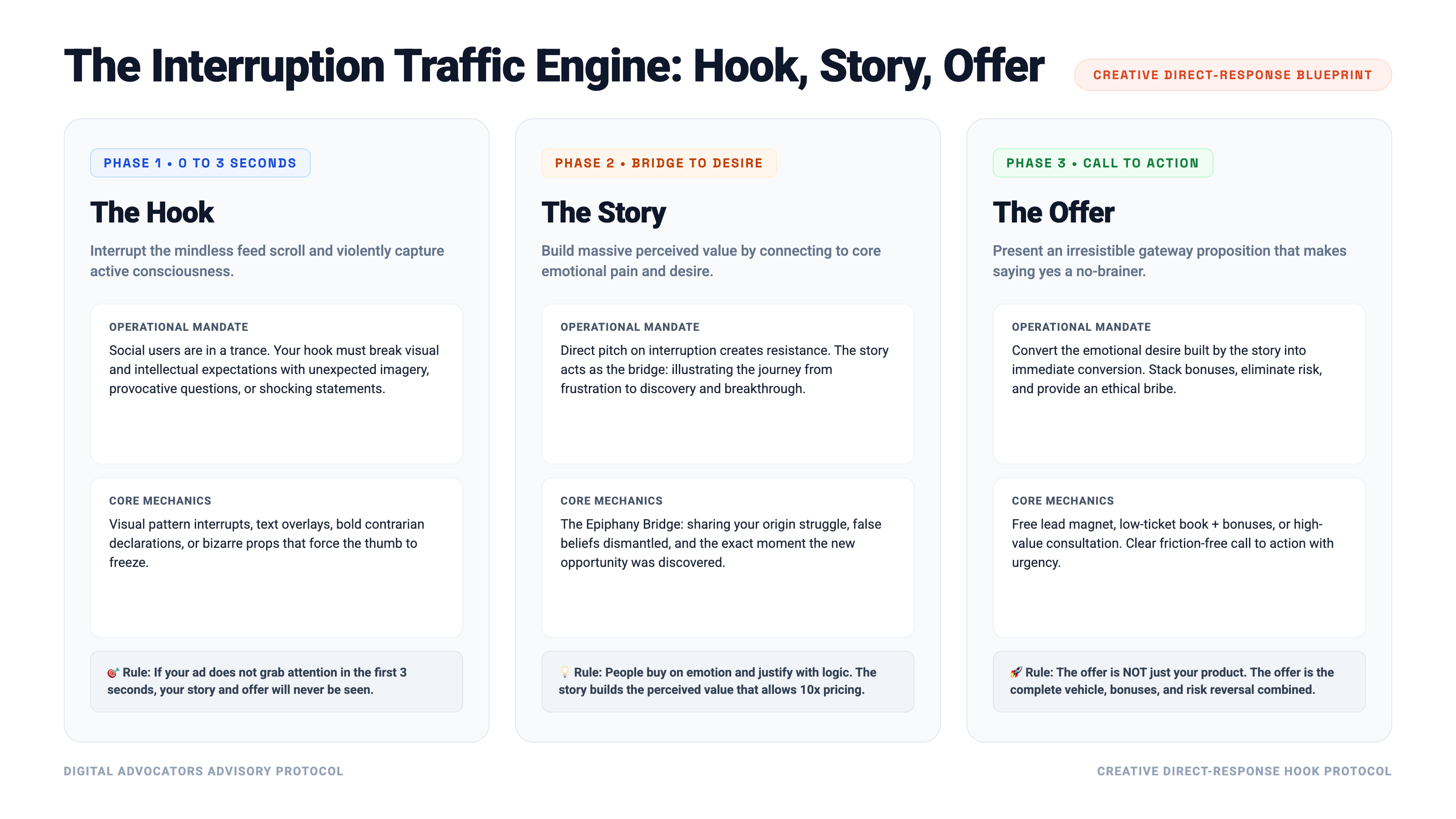
- Component 1: The Hook (0 to 3 Seconds): Your prospect is scrolling through social media in a semi-conscious trance. Your hook must break their physical and mental rhythm. It must grab their eyeballs and freeze their thumb with unexpected visuals, bold text, or contrarian statements.
- Component 2: The Story (The Epiphany Bridge): Once you have hooked their attention, you cannot jump straight into a hard sales pitch. The story acts as the emotional bridge. You share your backstory, the wall of frustration you hit, and the epiphany that led to your breakthrough.
- Component 3: The Irresistible Offer: The offer is NOT just your product. A product is a commodity. An offer is a stacked bundle: core vehicle, high-value tools, checklists, complete risk reversal, and urgency.
6. Message-to-Mindset Funnel Architecture
To achieve high return on ad spend (ROAS), your landing page and ad copy must match the traffic channel:
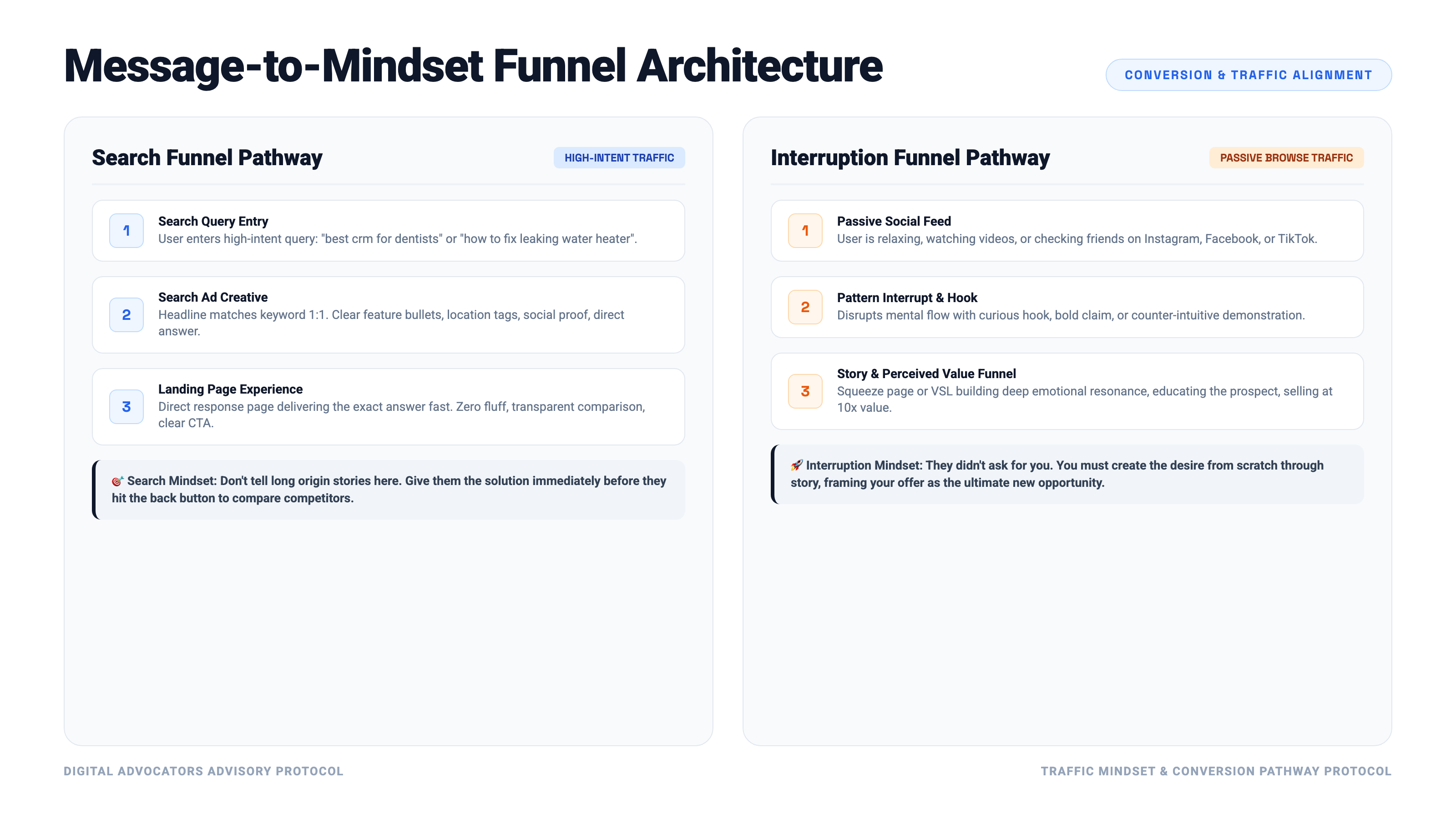
| Traffic Channel | Visitor Mindset | Ad Copy Style | Landing Page Structure |
|---|---|---|---|
| Google Search / Amazon | High-Intent Need: "I need this problem solved right now." | Clear, direct, keyword-matched, transparent features and reviews. | Direct-response landing page with fast answers, feature comparisons, and clear buy buttons. |
| Meta / IG / TikTok Ads | Passive Browse: "I am relaxing. Entertain me." | Pattern-interrupt hook, curiosity angle, emotional storytelling. | Squeeze page or VSL educating the prospect and building perceived value. |
7. Congregation Discovery: Where Are They When Not Searching for You?
If your dream customers are not actively searching Google for your keywords, where are they? They are congregating in existing communities centered around their passions and problems.
The instructor illustrated this with two real-world operational examples:
Case 1: The Copywriter in the Hair Salon
"I have a close friend named Mike who is an elite direct-response copywriter. He was hired to write a multi-million-dollar sales campaign for a female skincare product.
Mike was stuck. He told me: 'Russell, I am a guy. I have no idea how women think about skincare, what their deep fears are, or what vocabulary they use when talking to each other.'
Lesser copywriters would have guessed or written generic copy. Mike went to a local women's hair salon. He spoke with the salon owner, got permission to sit quietly in the corner with a notebook, and listened for three full days.
He listened to women talking openly about aging, marriage, confidence, and how they felt looking in the mirror each morning. He filled entire legal pads with their exact words, fears, and expressions.
He used their exact phrasing to write the sales letter. The campaign crushed records because it reflected their authentic voice back to them."
Case 2: The College Wrestling Website (TheMat.com)
"When I wrestled in college at BYU and Boise State, every wrestler had to attend mandatory study hall for two hours every day so we wouldn't fail our classes.
Every single wrestler in the study hall was on the exact same website: TheMat.com. We were all on the discussion boards debating matches, talking about national tournaments, and arguing about technique.
If you were a company selling wrestling shoes, headgear, or supplements, where would you go? You wouldn't waste time trying to guess. You would go directly to TheMat.com, sponsor the message boards, and run banner ads directly in front of the congregation!"
8. Step-by-Step Implementation Roadmap
To execute the teachings of Session 2 so you never have to rewatch the video, execute these two core exercises:
- Exercise 1: The Search Keyword Matrix (Needs vs. Wants): Open a two-column sheet. In Column 1, list 25 raw phrases your prospect types when experiencing cold pain (e.g., "why am I always tired" or "how to get consulting clients"). In Column 2, list 15 phrases they search when solution-aware (e.g., "best keto meal plan" or "sales funnel software comparison").
- Exercise 2: The Interruption Congregation Audit: Identify the 10 top podcasts your dream clients listen to, the 10 authority online groups or subreddits they visit daily, and the 10 key influencers they follow. Then draft 3 distinct visual pattern interrupts and bold headlines designed to freeze their thumb in the feed.
