Coaching Audibles, Offer Diagnosis, and Funnel Troubleshooting: Escaping the Technician Trap and Becoming an Uncapped Rainmaker
Field notes and direct-response masterclass breakdowns on Session 5: How to execute real-time funnel audibles at the line of scrimmage, diagnose underperforming front-ends, shift from a capped technician into an uncapped rainmaker, and command uncapped performance revenue.
In direct response, theory is easy. Every operator can sketch an idealized funnel diagram on a whiteboard. But when real capital is deployed into live ad networks, theoretical plans collide with market reality: ad costs spike, click-through rates decline, front-end conversions stall, and prospects abandon checkout carts.
In American football, an audible is a play called by the quarterback at the line of scrimmage when the defensive front exposes that the pre-planned play is doomed to fail. Direct-response veterans do the exact same thing: they run a structured 4-part audit to pivot hooks, vehicles, economics, and environments in real time.
- The Anatomy of a Coaching Audible: Why rigid business plans collapse in live media buying, and how to read market resistance at the line of scrimmage.
- The Three Commercial Roles: The economic divide between the Technician (hard income cap), the Entrepreneur (extreme liability), and the Rainmaker (uncapped earnings with protected risk).
- The Trap of Technical Specialization: Why working 16-hour days as an hourly production specialist leads to burnout, and why the market rewards outcomes, never labor.
- The Direct-Response Value Shift: Transforming technical deliverables into customer-acquisition assets with performance revenue splits.
- The 4-Stage Audible Diagnostic Matrix: Hook & Pre-Frame, Opportunity Vehicle, Front-End Unit Economics, and Selling Environment.
- Covenant Decisions vs. Scarcity Hesitation: Why commitment commands resources, and how cutting off alternative escape routes accelerates breakthrough.
- Verbatim 3-Minute & 5-Minute Implementation Work Sessions: Complete audit worksheets for immediate deployment.
1. The Anatomy of a Coaching Audible: Reading the Defense at the Line of Scrimmage
Entrepreneurs often believe that successful direct-response campaigns emerge fully formed from brilliant brainstorms. They launch an offer, watch the initial numbers, and if the campaign doesn't produce instantaneous riches, they conclude that "funnels don't work in my niche."
Direct-response veterans know that no marketing campaign survives first contact with live traffic unchanged.
"In live football, the defense disguises their blitz. When you walk up to the line of scrimmage, you see safety pressure that will blow up your pre-called run. You don't walk off the field and quit football. You scream the audible, check into a quick pass, and exploit the defense's weakness.
When you deploy ad spend into Facebook, Google, or YouTube, traffic will show you its defensive front immediately. High bounce rates? Your pre-frame is weak. High opt-in but zero sales? Your vehicle is an improvement offer. Negative cash-flow? Your order bump is missing. You call the audible at the line of scrimmage."
2. The Three Commercial Roles: The Zero-Ceiling Law
To understand why so many talented operators remain trapped in feast-or-famine financial cycles, direct-response leaders analyze the three fundamental economic archetypes:
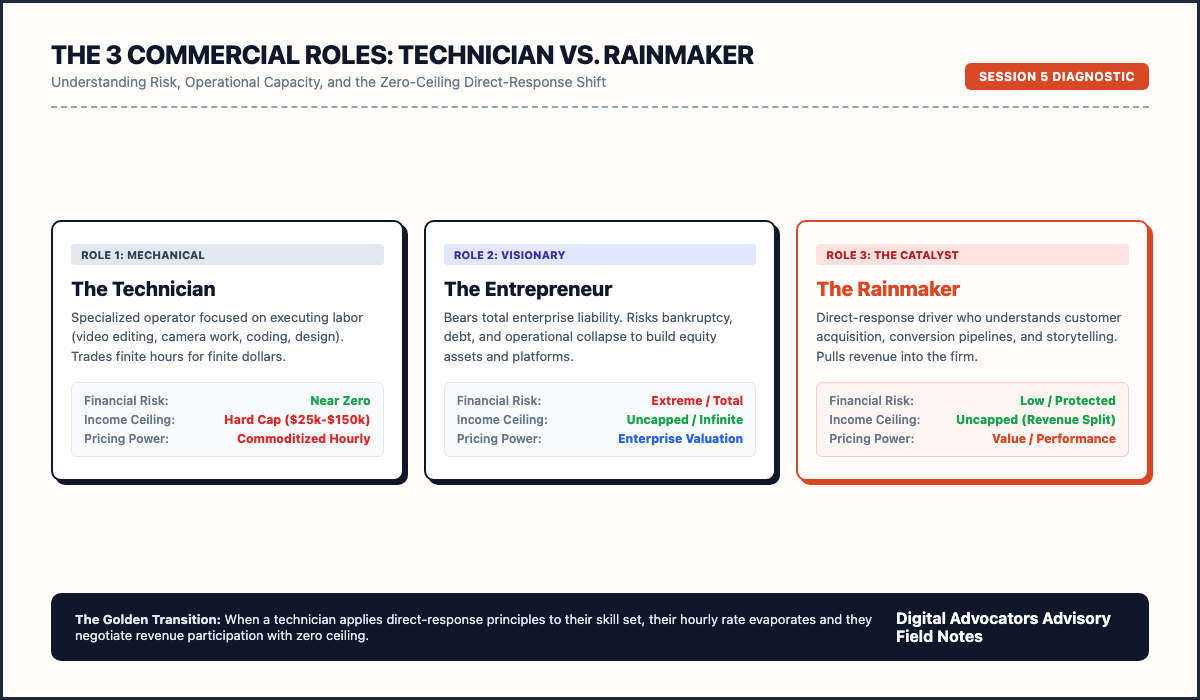
Archetype 1: The Technician (The Low-Risk, Capped Ceiling Trap)
The Technician is an expert at executing mechanical tasks. They are video editors, graphic designers, copywriters, software developers, accountants, and even surgeons. Technicians trade finite units of time for finite sums of money. Regardless of how gifted a technician is, the market imposes a hard price ceiling on labor. A camera operator might charge $500 a day; an elite editor might charge $1,000. Even if they work eighteen hours a day until physical exhaustion, their earning power is mathematically capped.
Archetype 2: The Entrepreneur (The High-Risk, Infinite Ceiling Asset)
The Entrepreneur is the individual who creates the vehicle. They rent the building, hire the staff, secure lines of credit, purchase inventory, and sign personal guarantees. Entrepreneurs bear 100% of the catastrophic risk. If the business fails, the staff still demands payroll, the landlord demands rent, and the entrepreneur faces bankruptcy. In exchange for assuming total liability, the entrepreneur has no income ceiling.
Archetype 3: The Rainmaker (The Low-Risk, Uncapped Direct-Response Driver)
The Rainmaker is the rarest and most lucrative operator in the commercial ecosystem. A Rainmaker does not carry corporate debt or sign personal office leases. However, a Rainmaker understands how to make it rain: they master customer psychology, audience congregations, direct-response copy, and traffic conversion pipelines. When a Rainmaker enters a business, they bring in paying customers. Because a Rainmaker generates self-liquidating cash-flow, their compensation can be directly tied to revenue splits and performance bonuses—giving them infinite earning power with protected risk.
3. The Great Shift: From $250 Commodity to $50,000 Revenue Driver
Consider the personal turning point of an operational specialist who broke free from the Technician archetype:
"For years, I was working twelve to sixteen hours a day lifting heavy camera gear, setting up studio lighting, and editing video clips for local businesses. I was exhausted, stressed, and terrified to quote a client $250 for a video because I was afraid they would say no.
My family was living in a rented basement apartment, qualifying for state food assistance, and being audited for assistance eligibility while I was working myself to the bone. The breakthrough came when an experienced direct-response mentor broke down my economic reality:
'In the eyes of the market, you are functioning as a technician. Technicians are hired out of a finite production budget. If a business has $5,000 for marketing materials, you are fighting for a tiny sliver of that expense.
If you shift your mindset from Technician to Rainmaker, everything changes. You don't sell videos. You sell client acquisition systems. You go to an agency, a coach, or an e-commerce firm and say: I will craft the hooks, stories, and video ads that bring you customers. If I generate $100,000 in front-end revenue for your firm, you pay me a percentage of the cash collected.
Suddenly, you are no longer an expense to be minimized; you are an investment that prints cash.'
That single mental shift transformed my business. Within months, I stopped taking hourly gigs, partnered with high-ticket clients, and negotiated performance revenue splits that paid more in a single campaign than I previously earned in two years of mechanical labor."
4. The 4-Stage Coaching Audible Diagnostic Matrix
When a live marketing funnel stalls, direct-response leaders run the campaign through the 4-stage line-of-scrimmage diagnostic:
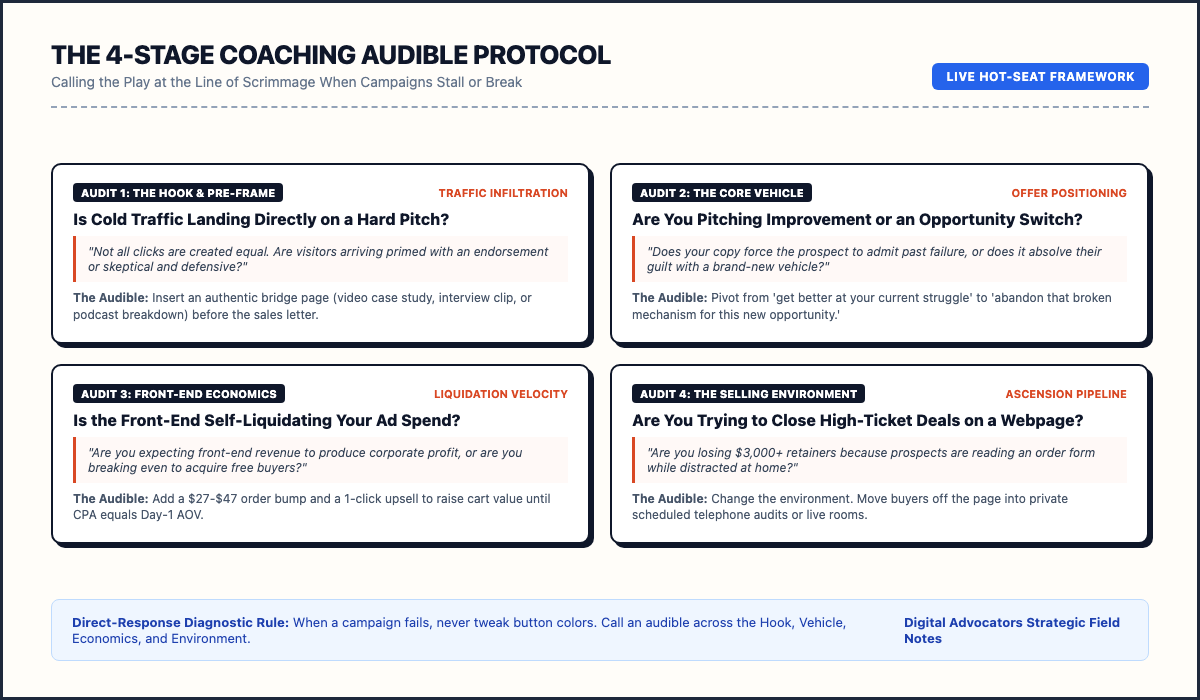
Stage 1: The Hook & Pre-Frame Audit
Are visitors arriving primed, receptive, and trusting—or cold, defensive, and cynical? If prospects are landing on your offer page cold, conversion rates will remain suppressed below 1%. Deploy a Pre-Frame Bridge: a 3-minute video breakdown, an interview with an established authority, or an unvarnished case study that transfers credibility before the pitch.
Stage 2: The Core Vehicle Audit
Does your offer force the customer to admit they failed, or does it offer a brand-new vehicle? If you sell an "Improvement Offer" ("Work harder at your current diet," "Write better emails"), prospects resist because buying forces them to admit personal failure. When you pivot to an Opportunity Switch ("The old vehicle was broken; here is the new direct-response protocol"), the prospect's guilt is absolved and enthusiasm restarts.
Stage 3: The Front-End Unit Economics Audit
Does Day-1 Cart Value fully liquidate Customer Acquisition Cost (CPA)? If you spend $40 to acquire a customer and only sell a $15 front-end ebook, you lose $25 on every transaction. Call the audible: inject a high-converting order bump ($27-$37) and an immediate 1-click OTO ($97) to push your Day-1 Average Order Value (AOV) to $45+. Your traffic is now 100% free.
Stage 4: The Selling Environment Audit
Are you asking prospects to make a life-changing investment while sitting distracted on a smartphone? High-ticket consulting, agency retainers, and enterprise services cannot be sold through digital sales letters. You must change the environment: transition prospects into a scheduled 1-on-1 diagnostic phone call, send a physical direct-mail dossier, or invite them into an intimate live room.
5. Step-by-Step Implementation Work Sessions
Execute these three operational exercises. These are the exact work sessions conducted in Session 5:
| Daily Activity | Current Role | The Rainmaker Shift | Earning Ceiling |
|---|---|---|---|
| Editing videos, tweaking CSS, designing graphics | Technician | Package as reusable customer-acquisition templates | Capped Hourly |
| Writing ad copy & managing media spend | Rainmaker | Negotiate a 20%-40% profit share on front-end revenue | Uncapped |
| Building joint-venture bridges with Influence 100 | Rainmaker | Construct self-liquidating front-ends for partner audiences | Uncapped |
Inspect your current primary acquisition funnel against the 4 diagnostic checkpoints:
- Pre-Frame Score: Are cold clicks hitting an unvarnished endorsement bridge before the sales letter?
- Vehicle Check: Does your headline pitch improvement (triggers resistance) or an opportunity switch (absolves guilt)?
- Liquidation Math: Does Day-1 AOV equal or exceed CPA? What order bump can you deploy today?
- Environment Check: Are you attempting to close $3k+ deals on digital pages instead of telephone audits?
Draft an uncapped performance proposal for one partner in your marketplace:
