Pillar #3: Attention, Story, Offer, and the Authority Persona
Once you know who your dream customer is (Pillar #1) and where they are congregated (Pillar #2), you face the decisive tactical challenge of direct response:
How do you actually pull them out of those digital congregations and into your funnel?
Amateur marketers believe that getting traffic requires complex technological trickery, secret media-buying algorithms, or multimillion-dollar production studios. When their ads or funnels fail, they blame the ad network, claim "Facebook ads don't work anymore," or rewrite their entire sales copy at random.
Direct-response masters operate by a simpler, timeless law:
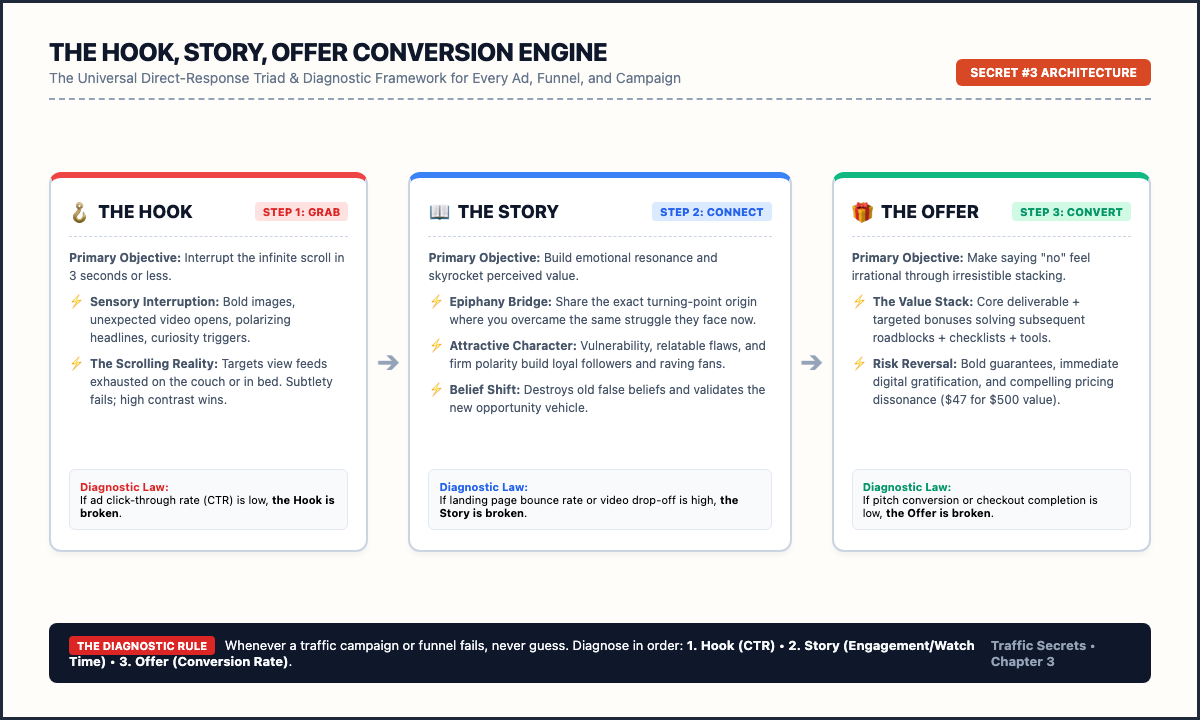
The Universal Conversion Law: Every advertisement, email, video, podcast, blog post, and landing page in existence relies on a single conversion triad: Hook, Story, and Offer. If your traffic campaigns are not generating clicks, leads, and sales, it is never because the algorithm is broken. It is always because of the Hook, the Story, or the Offer.
1. The 9:27 PM Couch Epiphany: Anatomy of a Pattern Interrupt
Picture a typical target customer. Let us call her Jessica.
It is 9:27 PM. After fourteen grueling hours of managing client demands, driving carpools, preparing dinner, and putting exhausted children to bed, the house is finally silent. Jessica collapses onto the living room couch. She is physically drained, mentally overwhelmed, and completely alone with her thoughts.
She pulls out her smartphone. She is not looking to buy software, purchase a coaching program, or evaluate business opportunities. She is seeking numbing comfort—scrolling through her social media feed to verify that other human beings are surviving the same chaotic daily reality.
Her thumb rapidly flicks upward across the glass:
- A generic vacation photo... swipe.
- A corporate brand announcement... swipe.
- A political rant... swipe.
- A polished, sterile agency ad... swipe.
Suddenly, her thumb halts. She reverses the scroll by two inches, centering an image on her screen.
The image is not a polished studio glamour shot. It is a photo of a relatable woman her own age in workout shorts during an exercise session—with a prominent dark spot visibly spreading across the fabric.
Above the photo, a bold caption reads:
"Let me tell you about the time I accidentally peed my pants during a workout video... I have never been so humiliated in my entire adult life."
Jessica laughs for a split second—and then the laughter catches in her throat.
Earlier that month, while jumping on a backyard trampoline with her children, she experienced that exact same embarrassing physical accident. She made up an excuse, rushed inside to change clothes, and spent the evening wrestling with intense shame and maternal guilt. She had silently resigned herself to believing that after childbirth, her body was permanently compromised.
Driven by visceral curiosity and relief that someone dared to speak the unspeakable, Jessica taps the image.
She is taken to a simple video page where the creator—a fitness educator and mother of two—shares her Epiphany Bridge story:
- She shares the raw humiliation of the incident while filming a live class.
- She recounts her discovery of a specialized physical therapist who identified the root cause: weakened pelvic floor muscles that standard abdominal crunches actually make worse.
- She explains how a series of simple, 10-minute at-home movements restored her core stability completely.
- Recognizing that millions of mothers suffer silently without access to specialized clinical therapists, she partnered with the doctor to assemble a complete home restoration protocol: the core digital guide plus bonus workout schedules, nutrition guides, and rehabilitation walkthroughs.
- The total clinic value exceeds $500, but she packaged the entire system into an immediate digital download for just $47.
Before 9:35 PM strikes, Jessica has sprinted across the living room, retrieved her credit card, and completed the checkout.
That single campaign generated over 120,000 paying customers and transformed a modest digital publisher into a multi-million-dollar category leader. It did not succeed through elaborate technological funnels; it succeeded because of flawless execution of Hook, Story, and Offer.
2. The Hook: Capturing Attention in the 3-Second Window
The hook is the mechanism that seizes attention long enough to earn the right to tell a story.
In modern traffic environments, your prospect is holding their phone in bed, on the subway, or on the couch. Their attention span is fractured. Every platform is designed to facilitate effortless swiping. If you do not interrupt their neurological pattern within the first three seconds, your story and your offer never exist.
📸 Visual Pattern Interrupts
Raw, unpolished smartphone imagery, jarring camera angles, high-contrast framing, or unexpected physical occurrences that shatter the predictable visual rhythm of social feeds.
✍️ Textual Curiosity Hooks
Polarizing opening lines, confessions of failure, counter-intuitive questions, and curiosity loops that force the prospect's internal dialogue to halt mid-sentence.
The Three Golden Rules of High-Converting Hooks:
- Subtlety Fails: If your hook looks like traditional advertising, the brain categorizes it as spam and swipes past it unconsciously. High-converting hooks feel like raw, authentic documentation from a peer.
- Curiosity Over Clarity at Step 1: The purpose of the hook is not to explain your product. The sole purpose of the hook is to stop the scroll and purchase thirty seconds of focused attention.
- Congruence with the Story: Never use cheap "clickbait" that does not organically bridge into your narrative. If your hook promises a revelation about an embarrassing workout failure, your story must deliver that exact emotional context.
3. The Story: Epiphany Bridges & The Perceived Value Explosion
Once the hook stops the scroll, you enter the story window.
Amateurs use this window to list product features, specifications, software integrations, and technical credentials. This triggers analytical resistance in the prospect's brain.
Direct-response masters understand that logic does not create desire; emotion creates desire, and stories are the universal currency of emotion.
The Epiphany Bridge Principle: When you share your origin story—the initial struggle, the wall of frustration, the moment of discovery, and the transformation—you allow the prospect to experience the exact same epiphany you had. When they reach that realization on their own, the desire to buy becomes their idea, not your sales pitch.
The Two Strategic Objectives of the Story:
- Exploding the Perceived Value of the Offer: An ebook containing pelvic exercises is worth $5 as raw information. But an ebook that encapsulates a doctor's clinical methodology, saves $2,000 in physical therapy copays, and restores personal dignity is easily worth $47, $97, or $297. The story creates the context that makes the price feel trivial.
- Building the Authority Persona Connection: Even if someone does not purchase immediately, a compelling story turns them into a subscriber, a student, and eventually a passionate brand advocate.
4. The Authority Persona: Archetypes & Cultural Resonance
Why do personal brands, bootstrapped founders, and vocal thought leaders regularly out-convert billion-dollar multinational corporations in paid traffic feeds?
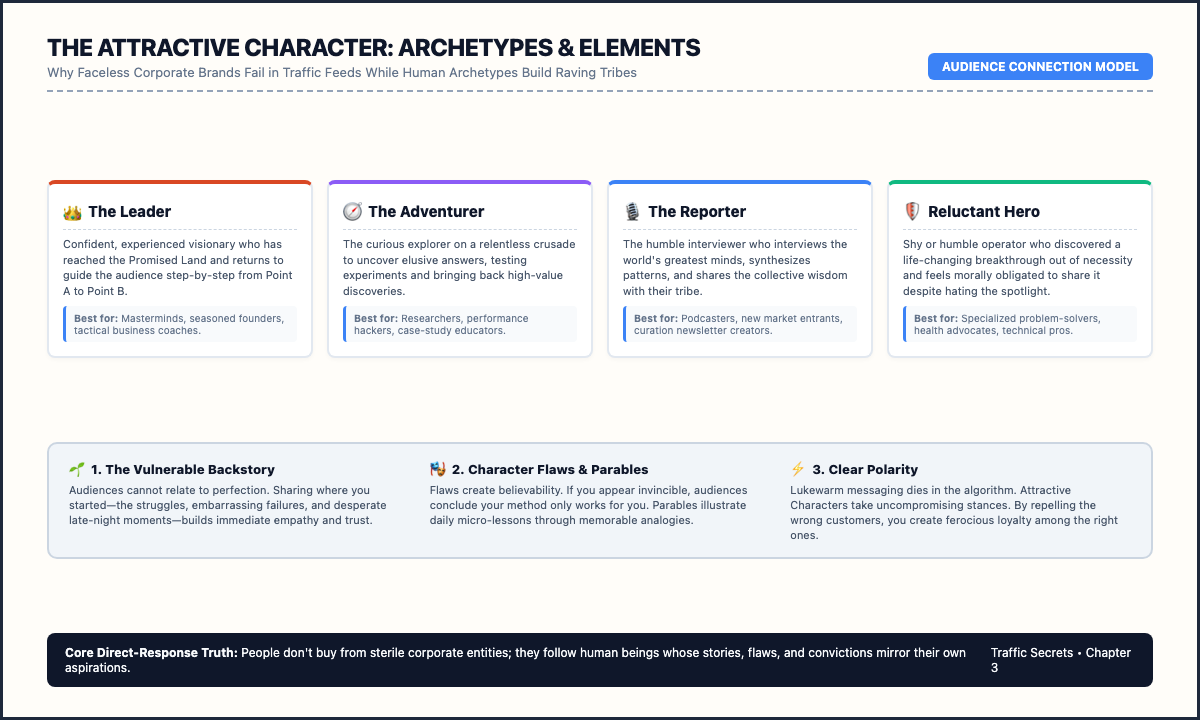
Because human beings do not form emotional attachments with faceless logos or corporate LLCs. People follow human beings whose convictions, struggles, and character traits mirror their own aspirations.
👑 1. The Leader
Confident visionary who has already conquered the promised land and guides the tribe safely from Point A to Point B. Ideal for executive masterminds and business coaching.
🧭 2. The Adventurer
Relentless seeker testing extreme experiments and uncovering hidden secrets to report back to the community. Ideal for biohackers, growth hackers, and researchers.
🎙️ 3. The Reporter
Humble student who interviews the world's foremost experts and synthesizes their collective wisdom for the benefit of beginners. Ideal for podcasters and media curations.
🛡️ 4. The Reluctant Hero
Introverted specialist who hates the spotlight but shares a breakthrough out of moral obligation to alleviate suffering. Ideal for medical advocates and technical specialists.
The Three Foundational Pillars of the Authority Persona:
- The Vulnerable Backstory: Invincible gurus repel buyers. If you never share your embarrassing starting point, your audience concludes your system only works because of your innate genius. Vulnerability creates relatability.
- Character Flaws & Daily Parables: Perfect people are irritating and unbelievable. Sharing quirks, mistakes, and real-time setbacks deepens loyalty. Daily parables link mundane occurrences to core business principles.
- Uncompromising Polarity: Lukewarm marketing produces lukewarm conversions. Authority Personas take distinct, polarizing stances. If you do not actively repel the wrong prospects, you will never inspire ferocious devotion in your dream buyers.
5. The Offer: Stacking Value to Make Saying "No" Irrational
The hook earns attention. The story generates emotional desire. The offer closes the transaction.
An offer is fundamentally distinct from a product:
- A Product is a single commodity item: a video course, an ebook, a software seat, or an hour of consulting. Products are instantly subject to price shopping.
- An Offer is an irresistible bundle: the core deliverable combined with proprietary bonuses, execution checklists, implementation software, community access, and ironclad guarantees that eliminate every perceived obstacle.
The Law of Offer Inflation: When people refuse your ads or abandon your sales page, amateur marketers instinctively slash prices. Never discount price; inflate the offer. In digital marketing, you increase conversion rates by bundling high-margin, high-perceived-value assets that solve the secondary friction points created by the core solution.
6. The Diagnostic Troubleshooting Engine: Locating Funnel Leaks
The greatest gift of the Attention, Story, Offer framework is diagnostic clarity. When a marketing campaign underperforms, panic is unnecessary. The metrics provide an immediate, unambiguous diagnostic roadmap:
| Symptom Observed | Broken Element | Exact Tactical Prescription |
|---|---|---|
| Low Ad CTR (< 1.0%) High Cost Per Click |
THE HOOK | Test 5 new raw visual opens; polarize headline; inject sensory pattern interrupts. |
| High Landing Bounce (> 75%) Video Drop-off (< 60s) |
THE STORY | Rewrite Epiphany Bridge; reveal vulnerable turning point; eliminate sterile feature lists. |
| High Cart Abandonment (> 70%) Pitch Silence / Zero Sales |
THE OFFER | Stack 2 speed/ease bonuses; institute bold risk reversal guarantee; highlight price dissonance. |
7. Hands-On Action Exercises & Work Sessions
Open your primary social media feed. Scroll at your normal speed for 60 seconds until an ad or post halts your thumb. Answer:
- Visual Interrupt: What exact image, video frame, or color contrast caused your thumb to pause?
- Curiosity Trigger: What was the opening hook line, and what emotion did it provoke (curiosity, humor, shared pain)?
- Advertiser Perception: Did you feel pitched to, or did you feel like you were discovering a peer's secret?
Define your Authority Persona persona across the three core resonance dimensions:
- Archetype Selection: Are you The Leader, The Adventurer, The Reporter, or The Reluctant Hero?
- The Humbling Backstory: What was your lowest, most frustrating starting point before discovering your breakthrough?
- The Polarizing Stance: What common practice in your niche do you completely reject?
Assemble your complete value stack to eliminate commodity price resistance:
