Pillar #2: Where Are They Hiding? The Influence 100 Architecture
How to locate the digital congregations where your dream customers already gather, leverage the Chet Holmes 90/10 doctrine, and deploy One-to-One vs. One-to-Many infiltration models.
Amateur marketers assume their buyers are randomly scattered across the web like needles in a haystack. The foundational law of direct response is that your dream customers are not scattered—they are already congregated.
Long before you launched, other authors, creators, and media publishers gathered your exact buyers into dedicated podcasts, YouTube channels, forums, and newsletters. By applying the Chet Holmes Influence 100 doctrine, you identify the ~100 entities that already control 90% of market attention and build systematic channels to work your way in and buy your way in.
1. The Law of Congregation: Finding the Digital Rooms
Consider the classic university study hall epiphany: collegiate athletes supposed to be writing term papers are caught grinning at their screens. A quick look reveals that every wrestler in the hall is logged into the same niche wrestling forum, passionately debating match techniques and tournament predictions with hundreds of thousands of fellow wrestlers worldwide.
That is the Law of Digital Congregation: Passionate people always congregate in specific digital hubs.
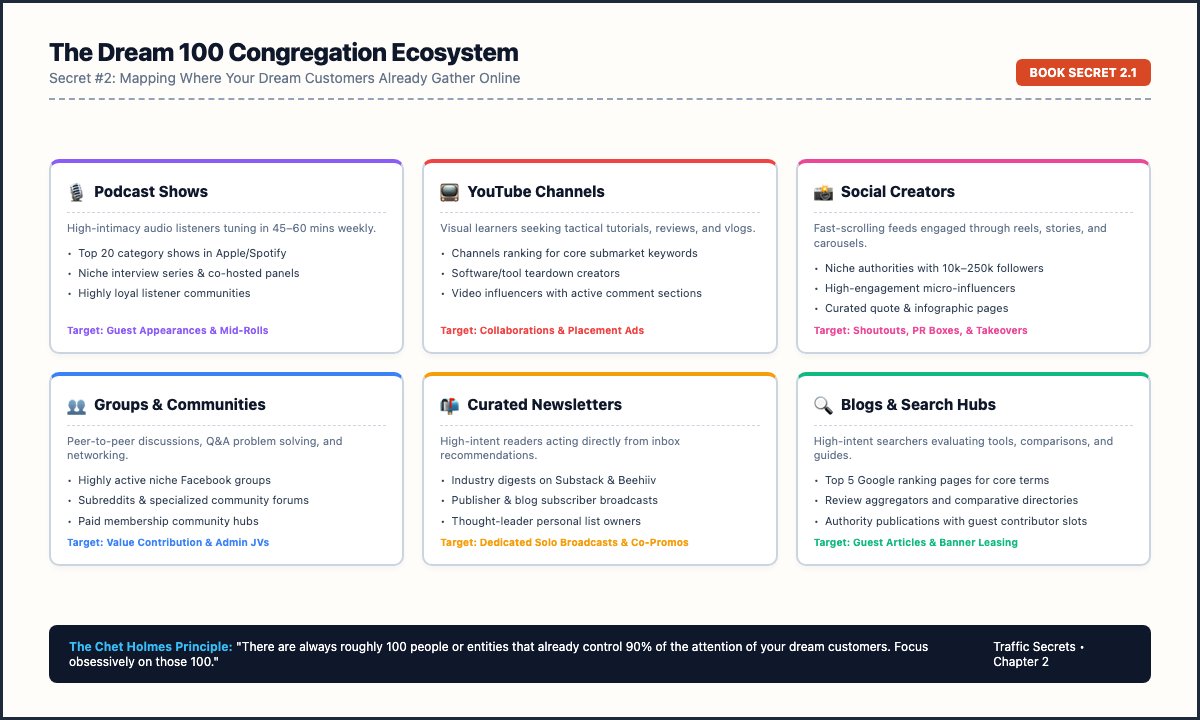
Your buyers are not an anonymous mass; they are members of specific digital tribes. They read the same 3 to 5 morning newsletters, listen to the same 5 to 10 industry podcasts during commutes, watch the same YouTube breakdown channels, and participate in the same specialized discussion groups.
2. The Origin of the Influence 100: The Chet Holmes Doctrine
The Influence 100 framework originates from legendary strategist Chet Holmes in The Ultimate Sales Machine. When hired to scale ad sales for a major legal magazine with over 2,000 potential advertisers, Holmes made a vital discovery: just 167 top advertisers purchased 90% of all ad pages in the entire industry.
- The Amateur Mistake: Calling 2,000 random firms with cold calls, exhausting energy on low-yield prospects.
- The Influence 100 Strategy: Ceasing all prospecting to the 1,833 marginal accounts; focusing 100% of effort on the 167 core spenders with persistent, high-value educational mailers and gifts.
- The Result: Sales doubled in 12 months and quadrupled in 15 months, capturing the #1 market share.
3. Two Core Types of Digital Congregations
When mapping your market's digital ecosystem, divide congregations into two distinct categories:
Gatherings formed around an objective problem, keyword, or hobby (e.g., subreddits, Google search queries, community forums, Facebook groups). Users seek solutions or peer support rather than a single guru.
Gatherings formed around an attractive character, author, podcaster, or YouTuber. Followers trust the creator’s lifestyle, opinions, and product recommendations.
4. One-to-One vs. One-to-Many: Choosing Your Strategic Model
How you deploy the Influence 100 depends strictly on your business model and deal economics:
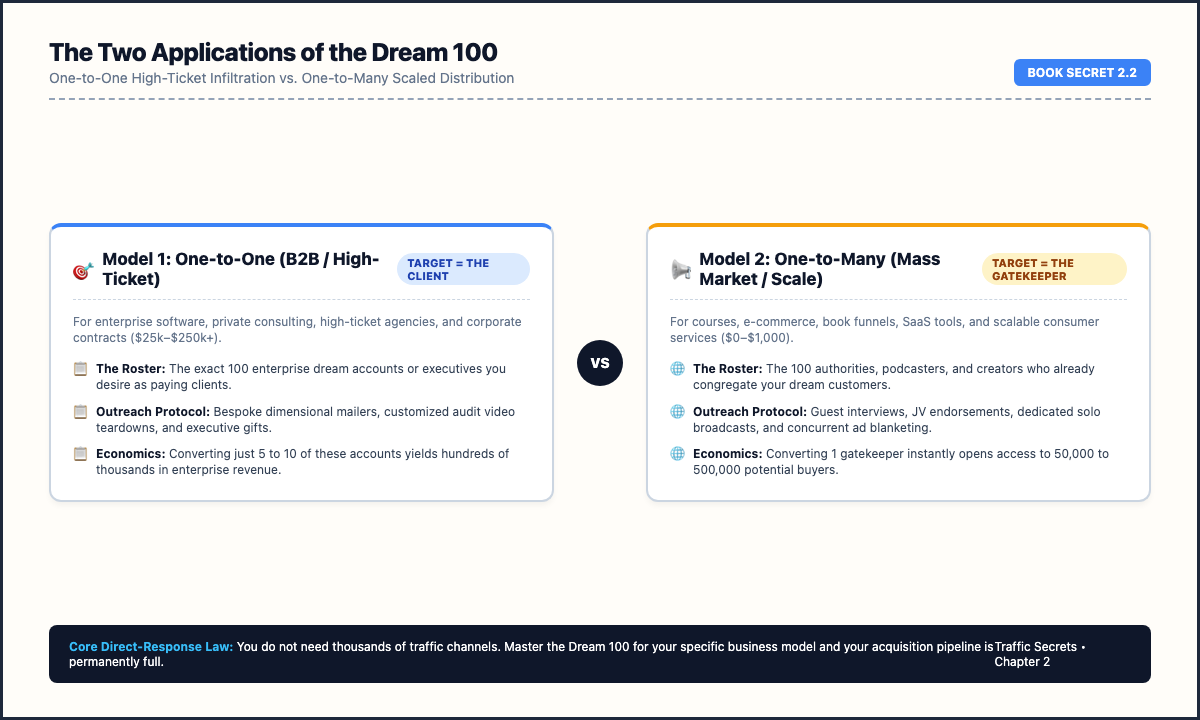
Model 1: One-to-One (High-Ticket / Enterprise B2B): If your service sells for $25,000 to $250,000+, your Influence 100 is the 100 specific corporations or executives you want as clients. You target them with custom audits, personalized video teardowns, and high-impact dimensional mailers.
Model 2: One-to-Many (Mass Market / Scale): If you sell low-ticket books, SaaS software, e-commerce products, or courses ($0–$1,000), your Influence 100 is the 100 influencers who control the attention of your buyers. Converting a single gatekeeper unlocks access to 50,000 to 500,000 customers.
5. Platform-Specific Roster Construction
Build a living spreadsheet organizing your top 100 targets across six native digital mediums:
- Podcast Shows (20 Targets): Pitch compelling founder stories and guest masterclasses.
- YouTube Channels (20 Targets): Offer products for live reviews and sponsor video integrations.
- Social Creators (20 Targets): Send curated unboxing gifts, sponsor reels, and coordinate joint live streams.
- Groups & Forums (20 Targets): Provide non-promotional high-value solutions to community questions.
- Curated Newsletters (20 Targets): Book solo dedicated promotional blasts and sponsor newsletter P.S. sections.
- Search & Review Hubs (20 Targets): Lease top-banner ad real estate and sponsor updated comparison guides.
6. Verbatim Work Sessions & Action Exercises
Identify the top digital hubs where your dream customers gather right now:
Choose and configure your primary outreach architecture:
- Offer Deal Size: Is your core unit transaction high-ticket ($10k+) or front-end volume ($0–$1,000)?
- Target Definition: Are your 100 targets the actual end-clients (One-to-One) or audience gatekeepers (One-to-Many)?
- Upfront Gift Value: What free teardown, research report, or mutual JV incentive will you give before asking for anything?
Search and list 5 verified targets across each of the following 4 channels:
2. Show Name
3. Show Name
4. Show Name
5. Show Name
2. Channel
3. Channel
4. Channel
5. Channel
2. Publication
3. Publication
4. Publication
5. Publication
2. Authority Blog
3. Authority Blog
4. Authority Blog
5. Authority Blog
