Growth Hacking & Congregation Domination: The Media Circus, List Ownership, and Platform-Specific Influence 100 Infiltration
How elite operators eliminate traffic friction by stepping into pre-existing streams, conquering native influencer channels, and building million-dollar owned databases.
Amateurs struggle for months attempting to "create" traffic from nothingness. The fundamental reality of direct response is that traffic already exists in massive digital rivers. Your dream customers are already gathered in specific newsletters, podcasts, social groups, and search queries.
Your strategic mandate is twofold: (1) Execute the synchronized Hollywood Media Circus—blending earned Influence 100 interviews with concurrent paid ad blanketing, and (2) Divert every drop of attention into an owned customer email database. At the conservative benchmark of $1.00 per subscriber per month, your list is your company's sovereign economic engine.
1. The Fundamental Law of Traffic: Diverting Existing Attention
Consider an expert fly-fisherman. They never cast their line into a swimming pool hoping fish will spontaneously materialize; they travel to the specific mountain river where trout naturally congregate. Online advertising operates on identical physics: you never attempt to manufacture attention—you locate existing congregations and divert them.
Every single day, your target customers are consuming content across four established conduits:
- Reading dedicated morning newsletters from curated industry experts.
- Listening to 60-minute podcast deep-dives during daily commutes.
- Watching tactical teardowns and reviews on YouTube.
- Searching specific commercial and problem-solving queries on Google.
Marketing ceases to be an unpredictable guessing game once you identify the leaders who have already assembled those tribes.
2. List Ownership: The Sovereign $1/Subscriber/Month Valuation Lever
Rented platforms (social media followers, YouTube subscribers, ad network pixels) are volatile and vulnerable to sudden policy changes, bans, and algorithmic downgrades. The only digital asset your business truly owns is your customer database.
A well-nurtured direct-response email database conservatively yields $1.00 per subscriber per month in enterprise revenue:
- 10,000 Subscribers: $10,000/month • $120,000/year baseline cashflow
- 50,000 Subscribers: $50,000/month • $600,000/year baseline cashflow
- 100,000 Subscribers: $100,000/month • $1,200,000/year baseline cashflow
The Daily North Star Metric: When high-growth direct response companies scale, executive leadership tracks one single operational number every morning: "How many new qualified subscribers and buyers joined our list today?" When that metric climbs consistently, enterprise valuation compounds automatically.
3. The 3 Core Desire Oceans & Category King Positioning
All human commerce flows through three primary desire oceans: Health, Wealth, and Relationships. Inside each ocean reside dozens of competitive sub-markets.
Amateurs enter these sub-markets selling Improvement Offers ("My method is 10% faster, 5% cheaper, or slightly harder"). Improvement offers fail because they force the prospect to confront their past failures with that vehicle, provoking skepticism and price-slashing commodity competition.
Elite growth hackers engineer an Opportunity Switch. You declare the old vehicle structurally obsolete, relieve the prospect of past guilt, and introduce an entirely new category mechanism. By naming the category and defining the metrics, you establish yourself as the Category King.
4. The Hollywood "Media Circus" Launch Architecture
When a premier movie studio launches a superhero blockbuster, they do not casually post a trailer online. They execute an overwhelming, multi-channel Media Circus:
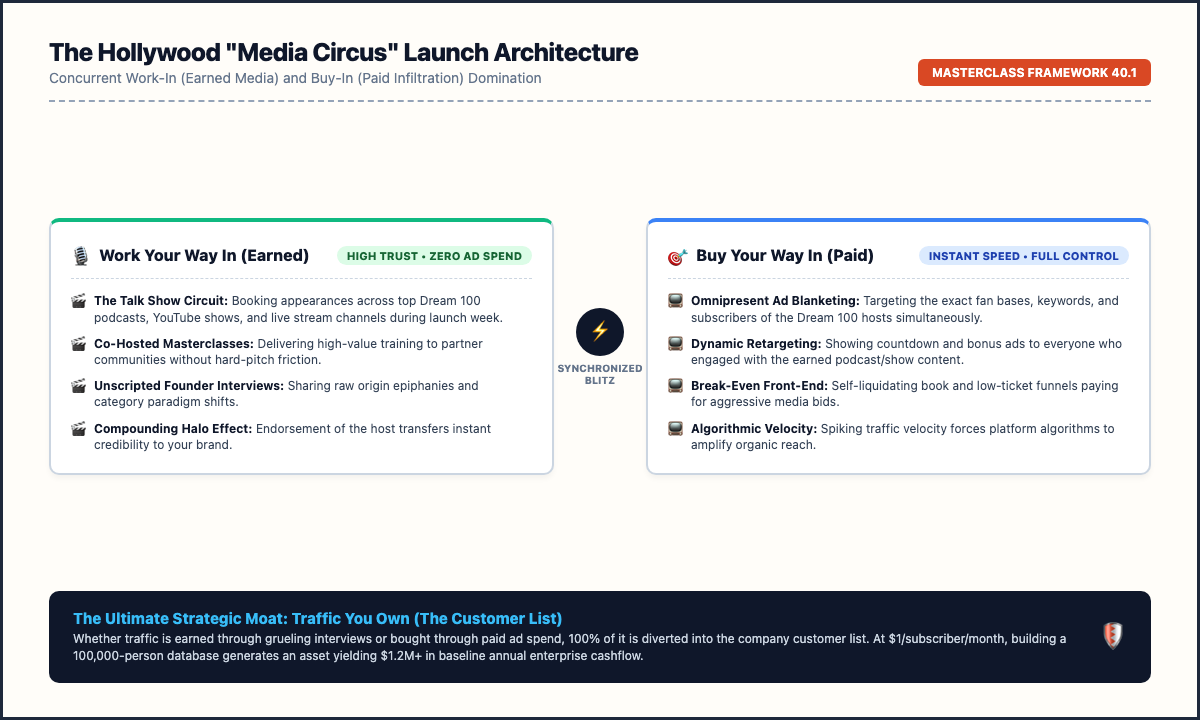
Book 20 to 30 guest podcast interviews, YouTube co-streams, and collaborative masterclasses during your launch sprint. The host’s built-in credibility and emotional trust transfer directly to you.
Simultaneously blanket those exact same audiences, keywords, and follower bases with paid ads and dynamic retargeting. Prospects hear you on an authority show and immediately see your ad.
5. The Platform-Specific Influence 100 Matrix
A frequent error in partnership outreach is cross-platform pitching. Asking an email newsletter creator with 400,000 subscribers to host an Instagram Live fails because that creator has no native presence or comfort on social video.
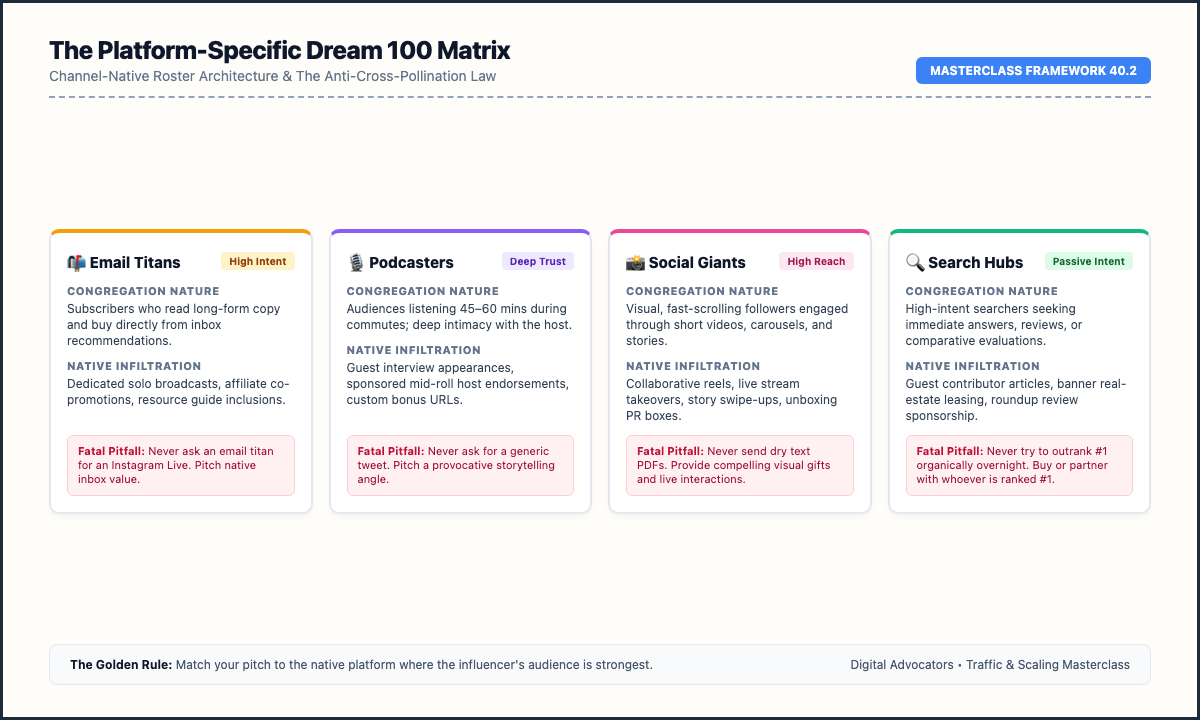
- Email Newsletter Titans: Pitch dedicated solo broadcasts, co-promoted diagnostic lead magnets, or P.S. sponsorship slots.
- Podcast Hosts: Pitch high-drama founder stories, provocative contrarian frameworks, and sponsored mid-roll recommendations.
- Social & Video Creators: Provide physical unboxing kits, collaborative carousels, and joint live stream challenges.
- High-Ranking Search Hubs: Never attempt to outrank the #1 search result organically overnight—contact the site owner and lease top-banner real estate or sponsor an updated comparison review.
6. Verbatim Work Sessions & Action Exercises
Complete your positioning framework to eliminate commodity resistance:
Identify 10 influential newsletter curators whose email endorsement would transform your front-end customer acquisition:
Map out a 14-day synchronized launch sprint combining earned media appearances and paid ad blanketing:
