Front-End Funnels, List Hacking, and Self-Liquidating Offers: The Break-Even Flywheel & The 10x Value Rule
Field notes and direct-response masterclass breakdowns on Session 14: How to eliminate customer acquisition costs through self-liquidating offers, apply the 10x value rule to pricing, solve Problem 2 through logical progression upsells, and borrow audience trust with Influence 100 list hacking.
Most business owners misunderstand the economic role of a front-end marketing funnel. They treat their front-end funnel like a traditional retail storefront, demanding that every $20 book or $37 starter kit generate massive corporate profits. When ad spend eats up their initial margins, they deem the campaign a failure and pull the plug.
Direct-response masters operate under an entirely different economic law: The Break-Even Flywheel. The purpose of a front-end Self-Liquidating Offer (SLO) is to liquidate 100% of your advertising costs immediately so that you acquire verified, paying customers for zero net dollars.
- The Break-Even Celebration Rule: Why breaking even on front-end customer acquisition is the ultimate victory in commerce, allowing infinite scale while competitors go bankrupt.
- The 10x Value Rule on Pricing: Calibrating perceived value at ten times asking price to eliminate price resistance ($3,000 value sold for $300; $500 value sold for $47).
- The Logical Progression Law: Why upsells fail when offering "more of the same," and why an irresistible OTO must solve the new problem created by Product 1.
- Influence 100 "List Hacking": Curating public masterclasses, extracting actionable frameworks, and adding tactical commentary to ethically borrow high-trust audiences.
- The 85,000 Leads Case Study: Why an "ugly" 1998-style plain white page generated 85,000 leads in 45 days at an unbelievable 78.9% opt-in rate.
- Compressed Warming Mechanics: Compressing months of traditional nurturing into a 90-minute live webinar or high-impact video bridge.
- Verbatim 3-Minute Work Sessions: Complete audit worksheets for immediate implementation.
1. The Myth of Front-End Profit: The Break-Even Celebration Rule
In traditional business, an entrepreneur measures success by Day-1 profit margins. If they sell a $50 physical product that costs $20 to fulfill, they expect to pocket $30 in immediate profit. When paid advertising enters the equation and customer acquisition costs climb to $40, the business collapses.
Direct-response veterans view front-end economics through the Break-Even Flywheel:
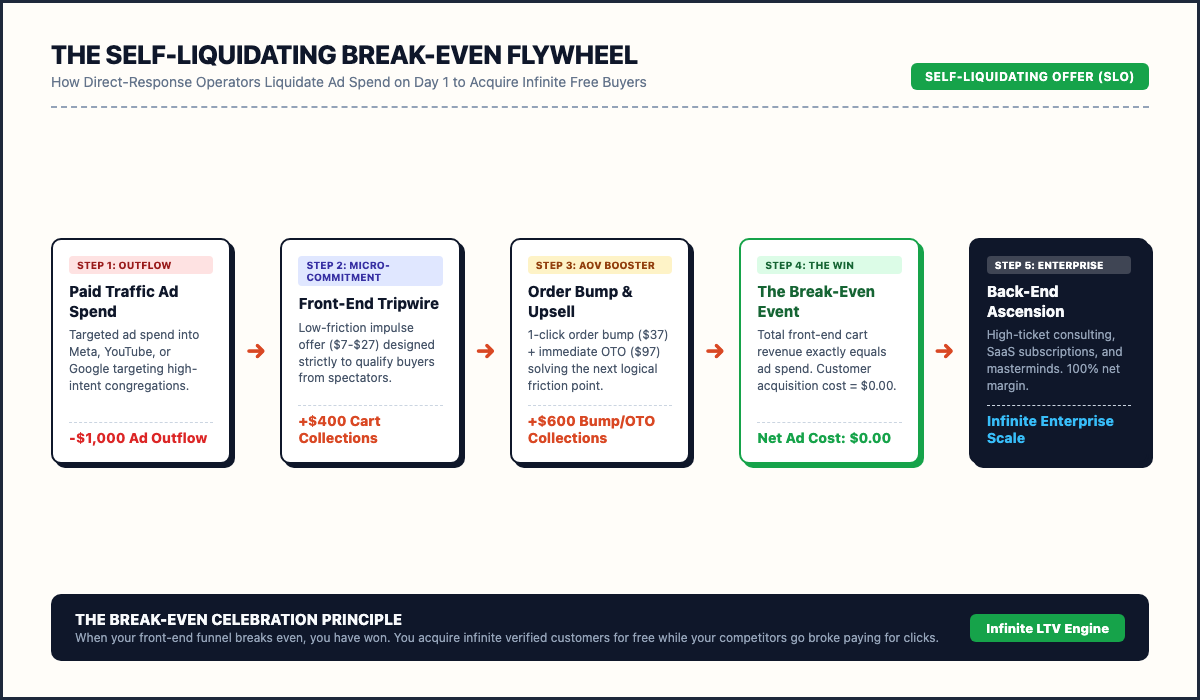
"When your front-end funnel breaks even, you should be celebrating, popping champagne, and hosting a party. Breaking even means you have acquired a paying customer, captured their primary email and phone number, verified their physical address, and established buying momentum—at zero net cost.
If your front-end breaks even, your business is virtually unkillable. Every back-end ascension, recurring subscription, and high-ticket service is pure enterprise profit."
2. The Logical Progression Law: Solving Problem 2 Created by Product 1
Why do 80% of upsells fail? Marketers mistakenly assume that if a customer bought an ebook on Facebook ads, they want to buy another ebook on Facebook ads. That is the "More of the Same" Trap.
Consider the natural human progression of commerce:
- When a prospect purchases a course on building sales funnels (Solves Problem 1: Strategy), what is the immediate new problem that emerges the moment they start building?
- Problem 2: Copywriting! "I have the funnel pages, but I don't know what words to put on the screen."
- If you offer them another course on funnel strategy, they reject it. But if you present an instant Headline & Email Copy Wizard Software that writes their sales copy in five minutes, the upsell is irresistible.
- When they purchase the copywriting software, what is the next acute problem? Problem 3: Traffic! "I have the funnel and the copy, but nobody is visiting my page."
- Every purchase in your Value Ladder should solve the immediate past problem while logically introducing the next layer of speed, automation, or done-for-you execution.
3. The 10x Value Rule on Offers & Upsells
When operators struggle with pricing, they invariably ask: "What price point should I charge?" In direct response, pricing is never determined by competitive benchmarking or personal insecurity. It is governed by the 10x Value Rule:
You do not price based on cost-plus margin; you price based on the actual, deliverable value of the transformation. Calibrate your offer so that the real perceived value is at least ten times the asking price.
If you are offering a solution with $3,000 in operational utility, price it at $300. If you are constructing an order bump that saves a client $500 in wasted software subscriptions, price it at $47. When a prospect perceives that they are receiving $10 of immediate utility for every $1 they hand over, price resistance dissolves.
4. Influence 100 "List Hacking": Curating Public Gold into High-Trust Bridges
You do not need to spend six months writing a 300-page book or recording a 40-hour course to launch an acquisition funnel. Through List Hacking, you can ethically borrow attention from established market leaders by curating free, public assets into high-utility bridges:
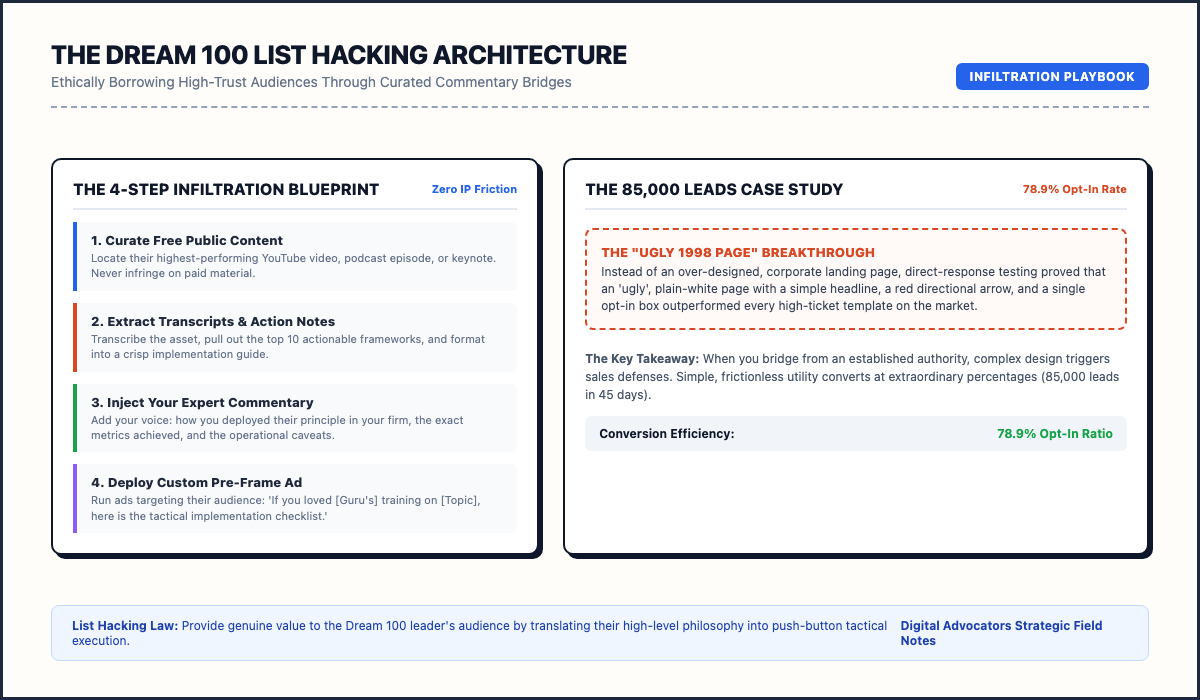
You are not infringing on copyright or stealing paid products. You are taking freely available public interviews, extracting high-level principles, and providing the missing tactical implementation that followers desperately crave.
5. The 85,000 Leads Case Study: The "Ugly 1998 Page" Breakthrough
Entrepreneurs often spend months and thousands of dollars hiring design agencies to build elaborate, parallax-scrolling landing pages. Direct-response split tests reveal an astonishing truth: hyper-polished design often suppresses conversion rates.
"Instead of an over-designed, corporate landing page, direct-response testing proved that an 'ugly', plain-white page with a simple bold headline, a red directional arrow, and a single opt-in box outperformed every high-ticket template on the market.
The result? 85,000 verified leads in 45 days at an unbelievable 78.9% opt-in rate.
When you bridge from an established authority, complex graphic design triggers defensive skepticism. A plain, functional page that promises immediate delivery of a specific utility converts at extraordinary percentages."
6. Step-by-Step Implementation Work Sessions
Execute these three operational exercises. These are the exact work sessions conducted in Session 14:
| Tier | Asset | Problem Solved | New Problem Created | Next Upsell (OTO) |
|---|---|---|---|---|
| Tripwire ($27) | Lead Gen Masterclass | How to find dream prospects | "I don't have ad copy or emails" | Headline & Email Swipe Vault ($47) |
| Order Bump ($37) | Video Ad Storyboards | What to say on camera | "I don't know how to edit videos" | Push-Button Video Template Pack ($97) |
| OTO 1 ($197) | Automation Toolkit | Manual tracking friction | "I want an expert to audit my funnel" | 1-on-1 Strategy Session Audible ($997) |
Map a custom front-end bridge for one Influence 100 leader:
- Target Leader: Choose an authority whose audience mirrors your avatar.
- Curated Asset: Locate their top public keynote or podcast interview.
- Tactical Derivative: Extract a 1-page implementation checklist or cheat sheet.
- Ad Hook: "If you loved [Leader's] breakdown on [Topic], here is our tactical execution checklist."
Audit your unit economics to reach break-even velocity:
